

What if the right wedding band isn’t the biggest one, but the one that fits each moment of your day? A booking a wedding band checklist turns that decision into a few clear choices, instead of a long list of questions that leaves you unsure where to start.
It’s reasonable to think about more than music. The lineup needs to suit your celebration, and the band’s schedule and setup need to fit the venue and the flow of the day. Consider those details together to make booking more straightforward.
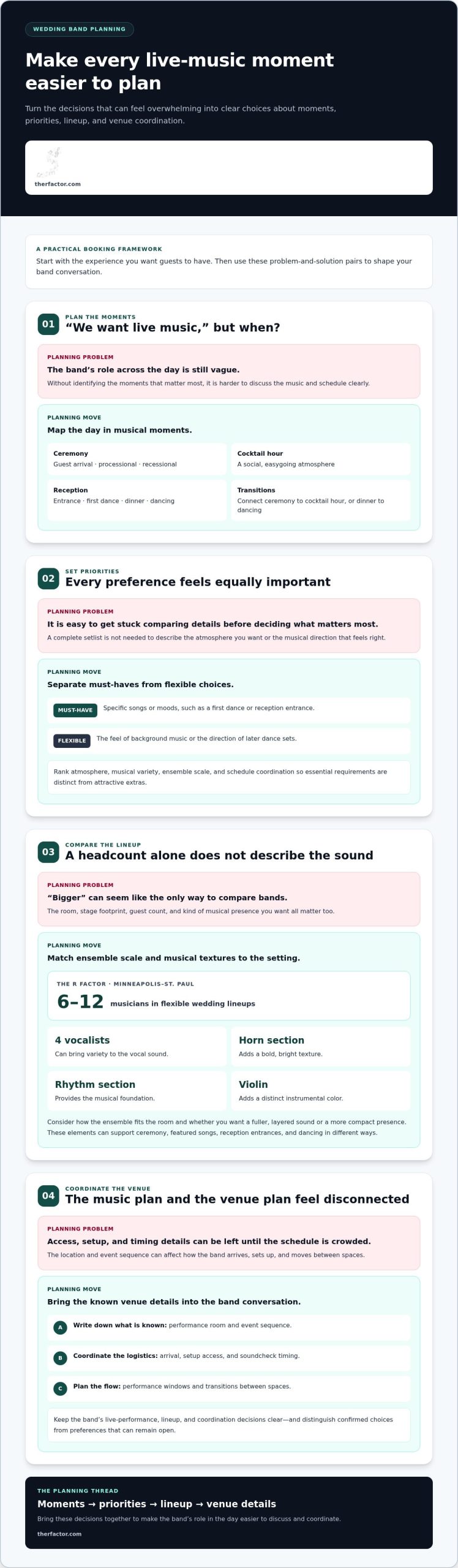
This guide will help you align your musical priorities, lineup, ceremony and reception plans, and venue logistics before the details become stressful. You’ll also see how The R Factor, a Minneapolis-St. Paul wedding band with flexible lineups of 6 to 12 musicians, can bring live music to ceremonies, cocktail hours, and receptions. The ensemble features four vocalists, a horn section, a rhythm section, and violin, giving you practical options as you shape the soundtrack for your wedding.
Key Takeaways
- Use a booking a wedding band checklist to turn your musical priorities into clear decisions about the moments you want live music to shape.
- Match the lineup and its vocal and instrumental textures to your wedding’s atmosphere and scale.
- Coordinate venue details, access, soundcheck, performance windows, transitions, and teardown with the people managing your day.
- Separate confirmed choices from open preferences so the final details are easier to review and put in writing.
- Explore how The R Factor’s 6-to-12-musician lineup can fit the music needs of your Minneapolis-St. Paul wedding.
Start Your Wedding Band Booking Checklist With the Experience You Want
Booking a band involves more than choosing songs. You’re balancing musical taste, the shape of the event, and practical details that affect how the day runs. Start with the guest experience you want, then use your booking a wedding band checklist to turn that vision into decisions you can discuss clearly.
Picture the wedding from your guests’ perspective. Should arrival feel relaxed and welcoming? Should the reception build gradually toward dancing, or shift quickly into a lively celebration? These priorities help guide band decisions without requiring you to settle every song or schedule detail at once.
Define the wedding moments live music should support
Write down when live music matters most. This gives you a practical starting point for discussing the band’s role across the day.
- Ceremony: Consider guest arrival, the processional, and the recessional.
- Cocktail hour: Decide whether you want music to create a social, easygoing atmosphere.
- Reception: Note the entrance, first dance, dinner, and dancing as distinct moments with different needs.
- Transitions: Consider how music should connect the ceremony to cocktail hour, or dinner to the dance portion of the reception.
Some moments may call for a specific song or mood, such as a first dance or reception entrance. Mark those as must-haves. Other choices, including the feel of background music or the direction of later dance sets, can remain flexible. A broad overview of Wedding Music Traditions can help you consider how music serves different parts of a celebration.
Set priorities before comparing wedding band details
Rank your priorities before comparing lineup options or musical range. Put atmosphere, musical variety, ensemble scale, and schedule coordination in order of importance. A clear ranking helps you distinguish essential requirements from attractive extras, especially when options involve different trade-offs.
Think about your guests without assuming they all share the same taste. Their age range, cultural backgrounds, and overlapping musical preferences can help you describe a musical direction that feels welcoming. You might want familiar songs across generations, for example, while keeping the overall mood polished and celebratory. You don’t need a complete setlist to explain that goal.
Keep band-booking decisions separate from your broader wedding music plan. The band conversation focuses on live performance, lineup, and coordination. Other music choices may involve different moments or arrangements. For a wider view of how music can fit the day, the live wedding music planning guide can help you map those decisions alongside the band’s role.
For Minneapolis-St. Paul couples, include the venue in these early conversations. The location and event schedule can shape arrival, setup access, soundcheck timing, and transitions between spaces. Note what you already know, such as the performance room and event sequence, then list details to coordinate. That gives your band discussion a local, practical foundation before the schedule becomes crowded.
Check the Wedding Band Lineup, Voices, and Musical Range
A lineup is more than a headcount. It shapes the sound, musical textures, and visual presence of the band, so compare those details with the room and the wedding atmosphere you want. The R Factor offers flexible wedding lineups ranging from 6 to 12 musicians. That range gives couples different ensemble scales to consider without treating “bigger” as automatically better.
Match ensemble scale to the wedding setting
Think about how the ensemble will fit the space and guest experience. A more intimate room may call for a different stage footprint than a spacious reception area. Consider whether you want a fuller, layered sound or a more compact presence, then weigh that against the room, guest count, and role live music will play. The 11-piece wedding band planning guide offers a closer look at how ensemble scale can shape a Minneapolis wedding.
Musical components matter as much as the number of performers. The R Factor’s ensemble features four vocalists, a horn section, a rhythm section, and violin. Multiple voices can bring variety to the vocal sound; horns add a bold, bright texture; the rhythm section provides the musical foundation; and violin adds a distinct instrumental color. Use this comparison to connect those elements to the moments you want the band to support:
| What to compare | What to consider | Wedding moments it can support |
|---|---|---|
| Ensemble size | Room scale, stage footprint, and desired musical presence | Reception entrances and dancing |
| Vocalists | Vocal variety and the overall sound you prefer | Featured songs and reception sets |
| Horn and rhythm sections | Brass texture, rhythmic drive, and musical fullness | Upbeat reception moments |
| Violin | Whether you want a distinctive instrumental layer | Ceremony or other moments suited to that texture |
Review repertoire and performance examples with purpose
Start with musical direction, not an exhaustive song-by-song review. Identify essential genres, shared favorites, and styles that don’t fit your vision. Then review performance examples and notice details a repertoire list can’t convey: how the vocals blend, how the instruments work together, and how the band carries its energy onstage. A list shows what a band may play; performance examples help you judge how that music sounds and feels.
For broader context on copyright and music, consult the U.S. Copyright Office’s Music Licensing and Copyright Law resource. Add your preferred lineup scale and musical direction to your booking a wedding band checklist, then explore The R Factor’s wedding band options as you refine the fit.
Coordinate the Wedding Band With Your Timeline and Minneapolis-St. Paul Venue
A clear music plan needs to fit the venue’s schedule and practical arrangements, not just the order of songs. For a Minneapolis-St. Paul wedding, coordinate early to understand the venue’s access windows, room setup, sound restrictions, and timing expectations. These details vary by venue, so record what the venue has established rather than assuming every space follows the same process.
Build a run of show around the live music
Map the day in order, then mark where the band performs and who cues each transition. A run of show gives the couple, planner, venue contacts, and band one shared working schedule.
- Collect venue details. Record the performance location, access times, room changes, sound restrictions, any curfew, and the relevant venue contact. Note which details are settled and which still need coordination.
- Map music moments. Place the ceremony, cocktail hour, reception entrance, dances, reception music, and final moments in sequence. Mark which moments call for live music and identify any specific cues.
- Align transitions. Consider how guests and the event move between spaces or portions of the day. Set a clear cue for moments such as the move from ceremony to cocktail hour or dinner to dancing, and identify who communicates that cue.
- Document logistics. Coordinate the band’s arrival, setup access, soundcheck, performance windows, and teardown with venue contacts. Include the agreed schedule and a simple method for communicating changes during the event.
A shared run of show reduces avoidable timing confusion by giving everyone the same sequence, cues, and contact points. Keep one current version and share updates with the couple’s planner, venue, and band. If the schedule changes, make sure each person working from it receives the same revision.
Account for venue logistics before the wedding week
Resolve practical questions before the final planning rush. Ask the venue to clarify its access window, any sound limits or curfew, the assigned performance area, and who will be the point of contact on the day. Setup needs depend on the venue and event plan, so coordinate those arrangements directly rather than assuming a standard setup applies everywhere.
Also decide how the team will handle a delay or room change. For example, the planner or designated venue contact can communicate a revised cue to the band, while the current run of show records the updated timing. Clear roles reduce last-minute guesswork.
Keep the written agreement aligned with the schedule. Performance windows, breaks, overtime terms, cancellation terms, and contingency plans are useful details to document. A sample Wedding Band Contract Essentials form can help you recognize topics to review; use the signed agreement between the couple and band as the record of agreed terms. Add unresolved venue questions to your booking a wedding band checklist, assign someone to follow up, and update the shared timeline when each detail is settled.
Use This Wedding Band Booking Checklist to Align the Final Details
Once you’ve settled on the experience, lineup direction, and schedule, put the live-band decisions in one place. This copyable worksheet keeps confirmed details separate from open preferences, so you can see what’s agreed and what still needs coordination. Keep it focused on the band’s performance rather than unrelated wedding tasks.
Document the decisions that shape the performance
For each item, mark Confirmed or Still to coordinate. Add a short note or name the person responsible for resolving an open detail. That turns a general reminder into a useful handoff for the couple, planner, venue, and band.
- Event moments: Ceremony, cocktail hour, reception, entrances, dances, and other moments for live music. Status: [Confirmed / Still to coordinate]. Notes: [Add details].
- Atmosphere and musical direction: Describe the mood you want and the musical range that suits it. Status: [Confirmed / Still to coordinate]. Notes: [Add details].
- Lineup: Record the selected ensemble direction and any lineup details that have been agreed. Status: [Confirmed / Still to coordinate]. Notes: [Add details].
- Priority music preferences: List essential songs or styles, along with preferences that can remain flexible. Status: [Confirmed / Still to coordinate]. Notes: [Add details].
- Timeline and cues: Note performance windows, transitions, entrances, and the current run of show. Status: [Confirmed / Still to coordinate]. Notes: [Add details].
- Venue logistics: Record the performance location, access notes, sound policies, relevant venue contacts, and any schedule restrictions. Status: [Confirmed / Still to coordinate]. Notes: [Add details].
- Written agreement: Track the agreed performance scope, schedule, responsibilities, and any changes. Status: [Confirmed / Still to coordinate]. Notes: [Add details].
Keep preferences distinct from commitments. “We like a relaxed start” is a useful direction, while a specific performance window or agreed cue belongs in the confirmed details. That distinction helps everyone understand what’s settled without treating every idea as a requirement.
Review the agreement and final planning handoff
Before the event, compare the written agreement with the latest schedule. Check that it reflects the agreed scope, performance timing, responsibilities, and documented changes. If an update affects the band’s timing or the venue plan, record it in writing and make sure the relevant people receive the same information.
Keep one final run of show accessible to the couple, planner, venue contact, and band. Retire outdated copies or clearly mark them as superseded, so no one relies on an earlier schedule. The checklist works best as a concise coordination record, not another broad planning document.
Use your completed notes to shape the next conversation. Explore wedding entertainment with The R Factor and bring your priorities into the planning process.
Plan Your Minneapolis-St. Paul Wedding Music With The R Factor
With your priorities, lineup preferences, and venue schedule in view, you can move from a general idea to a plan shaped around your wedding. The R Factor is a Minneapolis-St. Paul cover band for weddings, with live performances tailored to ceremony, cocktail-hour, and reception needs. Use the decisions in your booking a wedding band checklist to explain which moments matter most and how you want the music to support them.
Find a lineup that fits the wedding’s scale and moments
The R Factor offers flexible wedding lineups ranging from 6 to 12 musicians. Consider that range alongside your venue’s scale, the guest experience you have in mind, and the role of live music across the day. There isn’t one ideal lineup for every wedding. The useful question is which ensemble direction best fits your priorities and the setting.
The band’s ensemble features four vocalists, a horn section, a rhythm section, and violin. Those elements provide different musical textures to consider as you plan. You might prioritize vocal variety for reception music, a fuller instrumental sound for dancing, or violin as part of the atmosphere for a ceremony or cocktail hour. Connect these considerations to your event moments rather than choosing a lineup by headcount alone.
Share the practical context that can guide the conversation: where the band will perform, how the event moves between spaces, and which parts of the day you want live music to accompany. A ceremony followed by a cocktail hour and reception may call for a different plan from a reception-focused celebration. The R Factor tailors wedding performances to ceremony, cocktail-hour, and reception needs, giving you a clear starting point for discussing the day as a whole.
Take the next step with a clear plan
Prepare a short planning summary before discussing your wedding entertainment. Include your wedding date, venue context, preferred lineup direction, and priority music moments. Add the atmosphere you want guests to experience and any timing or transition details already recorded in your run of show. You don’t need every musical preference finalized. Distinguishing settled decisions from open preferences makes it easier to focus on what matters now.
This approach keeps the conversation specific. Instead of asking only which lineup is available, explain the setting and the moments the music should serve. Instead of bringing an unfiltered song list, share the musical direction and priority preferences that describe your vision.
Bring your notes and plan your wedding entertainment with The R Factor.
Turn Your Notes Into a Wedding Music Plan
Your checklist doesn’t need to be perfect to be useful. Treat it as a working brief: a clear record of what matters to you, what’s been decided, and which details still need a conversation. That makes it easier to move from general ideas to a plan that feels personal and fits the shape of your celebration.
Before taking the next step, choose the one open question that would make the biggest difference to your decision. It might be how the music should shift between parts of the day, or which lineup direction best reflects the experience you want. Bring that priority, along with your notes, into a conversation with The R Factor. A focused starting point helps keep planning practical while leaving room to tailor the live music to your wedding.
Use your booking a wedding band checklist to begin shaping that conversation. Start planning your wedding entertainment with The R Factor, and take the next step with a clearer sense of what matters to you. Your wedding music plan can grow from there.
Frequently Asked Questions
How far in advance should you book a wedding band?
Start once your wedding date and venue are set, especially if live music is central to your plans. Early planning gives you space to define the music moments, compare lineup directions, and coordinate venue requirements. For Minneapolis-St. Paul couples, begin the band conversation as those core details take shape.
Can a wedding band perform at the ceremony, cocktail hour, and reception?
Yes, couples can plan live music for several parts of the day. The R Factor provides wedding entertainment tailored for ceremonies, cocktail hours, and receptions. Treat each part as its own musical moment, then place it in the run of show alongside guest movement and key cues. The band’s role or arrangement doesn’t have to be identical throughout; shape the plan around the atmosphere and priorities for each segment.
Is a live performance video enough to judge a wedding band?
A video is a useful first impression, but it shouldn’t be your only reference. Review more than one representative clip and listen for details that matter to your event: vocal blend, instrumental balance, range across musical styles, and how the performers engage with the room. Compare those examples with your reception priorities. A recorded performance can inform your decision, but it can’t guarantee precisely how your wedding will feel.
What happens if the wedding schedule changes on the day?
Schedules can shift, so decide in advance who will pass updates to the band and venue. For example, the planner or designated event contact can relay a delayed entrance or a room change using the agreed communication method. Keep the current run of show easy to access, and make sure everyone can distinguish it from older versions. Document timing changes clearly; don’t assume every partner has heard an informal update.
Can couples request a special first-dance song from a wedding band?
Bring the first-dance song into the music-planning conversation early. Decide whether it’s a must-have moment or a preference, and record the agreed plan in your notes and written agreement. Include the song title and artist so everyone understands the request, and share any timing or cue information that affects the moment. Treat the request as settled once the plan is agreed with the band.
How many musicians are appropriate for a wedding band?
The right ensemble depends on the venue’s room, the scale of the event, your desired atmosphere, and the musical presence you want. The R Factor offers flexible wedding lineups ranging from 6 to 12 musicians. Rather than choosing by headcount alone, consider how the ensemble will fit the performance space and support your priorities. A booking a wedding band checklist can help you compare those factors before deciding.
What should couples share with their wedding band before the event?
Share the venue information, latest timeline, priority music moments, and the names and roles of key event contacts. Include access details and any venue sound or schedule requirements that affect the performance plan. If a room or timing changes, send the revised information rather than relying on an earlier draft. One current run of show helps the band and other event partners work from the same version.
Recent Comments