

What if live music could give your corporate event its own energy and identity? If you’re asking, “do I need a band for my corporate event,” start with what you want guests to experience. A live band can create a memorable focal point, but it may not fit every agenda, audience, or event format.
It’s reasonable to consider whether a performance might compete with conversation or scheduled programming. The key is choosing entertainment that supports the occasion, rather than adding music by default. A band can bring people together for a lively celebration, while a quieter musical role may better suit an event built around networking or presentations.
This guide will help you decide whether live music fits your event’s purpose, audience, and schedule. You’ll learn when a band adds value, how to balance performance with conversation, and what to consider when planning a musical package. The R Factor has been together for 30 years and tailors corporate event performances to the experience you want guests to remember.
Key Takeaways
- Answer “do I need a band for my corporate event” by matching the entertainment format to the occasion’s purpose and agenda.
- Compare a live band, DJ-led music, and a playlist by the atmosphere you want, the interaction guests expect, and how music fits the schedule.
- Plan around the performance structure: The R Factor’s standard quote covers a 4-hour event, with music arranged in sets and breaks.
- Use a short checklist to clarify your audience, event format, and the role music should play before selecting entertainment.
- Consider how The R Factor’s 4 singers, 8-piece band, and 6- to 12-piece on-site ensemble can shape a corporate event performance.
Do I need a band for my corporate event? Start with the event’s purpose
A band makes sense when a live performance advances the event’s purpose. If you’re asking, “do I need a band for my corporate event,” first define what the gathering should accomplish. Live music is a deliberate entertainment choice, not a requirement for every corporate occasion. A performance can create a shared focal point for a celebration, while an event designed around conversation may call for music to play a more discreet role.
Corporate gatherings can include very different moments. A networking reception may need a welcoming atmosphere that leaves room for conversation. At an awards program, guests need to focus on speakers and recognition. A company celebration may make room for a more prominent performance. If your event includes several of these modes, plan entertainment around the flow instead of asking one format to serve every moment. A general overview of corporate entertainment also illustrates the range of occasions and performances involved.
Match entertainment to the event agenda
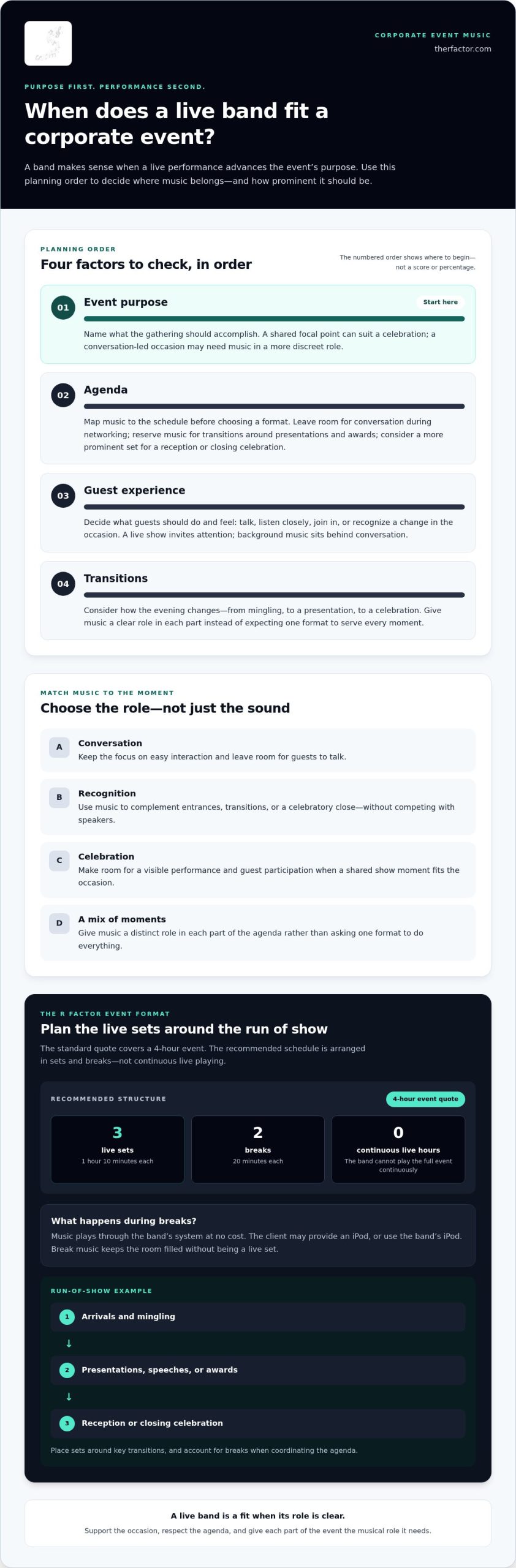
Map music to the schedule before choosing a format. During networking, guests should have room to talk. During presentations and awards, music can be reserved for transitions or other moments when it supports the program. A reception or closing celebration may be a natural place for a more prominent performance. That same approach could distract from a packed agenda of speeches and formal recognition.
Write down the event’s main purpose, then mark where music could support it. For example:
- Conversation: Keep the focus on easy interaction.
- Recognition: Use music to complement entrances, transitions, or a celebratory close.
- Celebration: Make room for a more visible performance and guest participation.
- A mix: Give music a distinct role in each part of the agenda.
This quick exercise can prevent a common mismatch: planning entertainment for the event’s final mood without considering what guests need during the rest of the program.
Decide what guests should experience
Music can support the atmosphere, or it can become a performance that commands attention. Those roles call for different expectations. If guests should talk, connect, or follow a speaker, music needs to fit around that experience. If they’re invited to participate, celebrate, or gather around a show moment, a live band can provide a visible focal point and bring a different energy to the room.
Consider the transitions, too. Guests might arrive ready to mingle, shift their attention to a presentation, then move into a celebration. Ask what you want them to do and feel at each stage. Should they keep talking, listen closely, join in, or recognize a change in the occasion? Live music works best when its role is clear. Once you define that role, you can decide whether a band belongs at a particular moment or whether another format better suits the event.
What a live band adds to a corporate event, and how its schedule works
A live band gives guests something to see and gather around, not just music in the background. The performers create a visible focal point that can turn a reception or celebration into a shared event moment. That distinction matters: a featured show invites attention, while background music is meant to sit behind conversation. Neither role suits every occasion, so choose the performance style to match the atmosphere you want.
If you’re asking, “do I need a band for my corporate event,” consider whether a live performance belongs in the room’s experience. Sets can mark a transition from mingling to celebration. If the schedule centers on speeches or focused conversation, consider how a visible performance will fit around those priorities. The goal is to give music a clear role that supports the event.
When live performance suits the room
A live show is a strong fit when the event calls for a shared moment, such as a company celebration or a reception that shifts into a more festive part of the evening. The performers become part of what guests experience, rather than simply a source of sound. If music should remain discreet behind conversation, a full live performance may be more prominent than the occasion needs. Decide whether music should set the scene or take center stage.
What the four-hour event format means
The R Factor’s standard quote covers a 4-hour event. The recommended schedule is 3 sets of 1 hour 10 minutes, spread throughout the night, with two 20-minute breaks included. The band cannot physically play continuously for the full 4 hours. Planning around sets and breaks gives organizers a clear structure for coordinating the performance with arrivals, dinner, speeches, and other program moments.
During breaks, music plays through the band’s system at no cost. The client may provide an iPod or use the band’s iPod. This keeps music in the schedule during breaks without confusing it with a live set. For example, an organizer might schedule a set after a formal program, then use a break to give guests time to mingle before the next performance. Align set times with the agenda so music complements key moments instead of interrupting them.
Before finalizing the schedule, mark the event’s important transitions and choose where a live set makes the most sense. Account for the breaks in the run of show, and share the timing with the event team so introductions, speeches, and the performance have a clear sequence. The R Factor’s custom corporate event music can be shaped around the tone and agenda you’re planning.
Live band, DJ, or playlist: which format fits your corporate event?
No single entertainment format suits every corporate event. A live band makes music a visible performance. DJ-led music uses recorded tracks, while a playlist offers selections chosen in advance. The right format depends on the atmosphere you want, how guests should interact, and what the agenda allows. Use the comparison below to clarify your priorities before deciding.
| Format | Atmosphere | Guest interaction | Agenda fit |
|---|---|---|---|
| Live band | A visible show with performers as a focal point | Guests experience the performance together | Best for a planned celebration or featured moment |
| DJ-led music | A music-led atmosphere shaped through recorded tracks | Attention can stay on conversation, dancing, or the program | Useful when music needs to follow changing moments |
| Playlist | A preselected musical backdrop | Music generally supports the gathering rather than leading it | Works when a planned selection is enough for the occasion |
Choose a band for a featured live-show experience
Choose a live band when you want the entertainment itself to be part of the occasion. The musicians are visible, and their performance gives guests a shared point of attention. This can suit a company celebration where a planned show moment belongs in the experience. A live performance plays a different role from quiet background music, so give it a place in the agenda rather than treating it as incidental sound.
Choose recorded or DJ-led music for different priorities
Recorded music may suit an event where conversation, presentations, or a tightly managed run of show should remain central. A playlist lets planners select music in advance. DJ-led music may suit an agenda that benefits from managing selections as moments change. These formats don’t create the same visible live performance, but they can be a better match when the priority is a controlled musical backdrop.
Think through what each format asks of the event:
- Choose a band if the performance should be seen and serve as a deliberate show moment.
- Consider DJ-led music if recorded selections need to follow different parts of the program.
- Consider a playlist if music can be chosen beforehand and mainly support the setting.
Then test your decision against the agenda. A reception that transitions into a company celebration may make room for a featured band performance. A presentation-heavy gathering may call for music that stays in the background. If the event has distinct phases, plan the musical role for each instead of assuming one format must carry the entire experience.
So, do I need a band for my corporate event? Choose one when a live, visible performance advances the occasion and fits the program. If your main priority is a flexible recorded-music backdrop, DJ-led music or a playlist may be a closer match. Decide based on purpose, interaction, and atmosphere, not by treating any format as the default.
Use this corporate-event checklist to decide whether a band is right
A clear decision starts with the event, not the entertainment. Before selecting music, write down what the gathering needs to accomplish and what guests should experience. This short checklist turns that purpose into a practical test: would a live show support the event, or compete with its main priorities?
Four questions to answer before booking
Work through these questions in order. Your answers should reveal whether a live performance belongs in the plan and where it can contribute most clearly.
- What is the event designed to accomplish? Name its main purpose, such as building connections, recognizing employees, celebrating a milestone, or combining several goals.
- Who is in the room? Consider whether guests are colleagues, clients, or a mix, and whether the occasion calls for conversation, participation, or a shared celebration.
- When should music contribute? Mark the moments when music could support the experience. A live performance may fit a celebratory segment better than a presentation or formal recognition.
- What role should music play? Decide whether it should sit in the background, support transitions, or become a featured show moment that guests can focus on.
Now apply the fit test. Imagine the band performing during the segment you selected. Would that visible show help express the event’s purpose and give the moment a clear focal point? Or would guests need to talk, listen to a speaker, or focus on another activity? If the performance competes with what guests are there to do, reconsider its placement or whether a live show is the right format.
Plan around the event’s distinct moments
Sketch the evening as a sequence: networking, scheduled programming, and celebration. Assign a musical role to each part instead of treating the agenda as one continuous block. Guests might need room to talk during arrivals, quiet attention during remarks, and a more celebratory experience later. Consider how performance breaks fit the flow, too. They can align with a meal, a program transition, or time for guests to reconnect.
This planning step helps you spot conflicts before they become schedule problems. If the agenda has no natural place for a featured performance, recorded music may better support the gathering. If a segment is intended to bring people together around a show, a band may be a strong fit. The 2026 corporate event live music guide offers further ideas for matching live music to an event plan.
Still asking, “do I need a band for my corporate event”? Use your answers to make the call: choose live music when its role is clear, the audience fits the experience, and the agenda gives the performance room to contribute. If those pieces align, learn about corporate event music with The R Factor.
How The R Factor tailors corporate event music in Minneapolis
The R Factor is based in Minneapolis and serves Minnesota and the surrounding five-state area. For planners who’ve decided a live performance suits their event, the next step is shaping the musical package around the occasion. The band has been together for 30 years and tailors its corporate event show to each client’s preferences.
The right musical choices depend on the event’s tone, audience, and agenda. A recognition dinner may call for a different feel from a company celebration. The R Factor’s in-house staff and music arrangers work with client preferences to shape the show, helping planners move from a general idea to a considered musical direction. If you’re still weighing “do I need a band for my corporate event,” consider whether a tailored live performance can support the experience you want guests to share.
A flexible ensemble and a tailored musical package
The R Factor’s 8-piece band consists of a 3-piece horn section, a 4-piece rhythm section, and 1 violin. The band features 4 singers and performs on-site as a 6- to 12-piece ensemble. Planners can choose an ensemble scale within that range, with the musical package shaped around the event and its preferences.
Customization also means aligning the musical approach with the occasion, whether the event calls for an elegant atmosphere, a celebratory show, or a blend suited to different moments. Share the event’s purpose and musical taste as you plan. That direction helps shape a performance connected to the gathering rather than a generic set of music.
A repertoire shaped around the event
The R Factor’s catalog contains over 750 songs. For an event, the band recommends selecting 50-60 songs. This focused selection gives planners a practical way to communicate musical preferences without planning every detail of the performance. Consider the audience, the tone of the occasion, and the moments when music should make the strongest contribution.
The band’s in-house staff and music arrangers use those preferences to tailor the show. A clear selection process helps connect the repertoire to the event’s identity, whether the goal is a polished corporate gathering or a more celebratory evening. The band’s 30 years together inform its experienced approach, while the musical direction is shaped around the client’s taste.
For more planning context, explore the live music for corporate events guide. When you’re ready to discuss how a tailored performance could fit your occasion, contact The R Factor about your corporate event.
Turn your decision into a clear event brief
If you’re still asking, “do I need a band for my corporate event,” make the next step a short brief. Write down the experience you want guests to remember, the moments when music should take focus, and the parts of the agenda that need room for conversation or presentations. Add a few words about the musical tone you have in mind. That gives your entertainment planning a practical starting point.
A clear brief makes it easier to discuss how live music could fit the event, where a performance might sit in the schedule, and what direction best reflects the occasion. You don’t need every detail settled before starting the conversation. Begin with the purpose and the feeling you want the event to create, then shape the musical plan from there.
Discuss your corporate event with The R Factor and take the next step toward an entertainment plan that feels intentional and personal. Your event has its own character. Give its music the same thoughtful attention.
Frequently Asked Questions
Can a live band work at a corporate event with networking?
Yes, a live band can work at a networking event if its performance has a deliberate place in the program. For example, keep the initial reception focused on conversation, then schedule a featured set as the event shifts toward celebration. This gives guests time to connect before music takes a more prominent role. Consider the purpose of each part of the gathering, not just the event as a whole.
Is a live band appropriate for a formal corporate event?
Yes, a live band can suit a formal corporate event when the performance matches its tone and timing. A recognition dinner might include live music during a reception or after formal remarks, while attention stays on speakers during the program. Formality doesn’t rule out live entertainment. Decide whether a featured performance enhances the occasion or whether music should remain secondary to the event’s main activities.
Can a corporate event band perform outside Minneapolis?
Yes. The R Factor is based in Minneapolis and serves Minnesota and the surrounding five-state area, including corporate events beyond Minneapolis and St. Paul. Include the event location alongside its format and schedule as you plan. That context helps shape the musical package around the occasion and gives planners across Minnesota and nearby states a live-music option for company gatherings.
How far in advance should I book a band for a corporate event?
Start planning once you have a likely date, event location, and broad outline of the agenda. There isn’t one booking lead time that applies to every corporate event, so avoid treating a general rule as a guarantee. If you’re asking, “do I need a band for my corporate event,” planning early gives you room to decide how live music could fit before the schedule is fixed.
Can a live band fit a company holiday party?
Yes, live music can fit a company holiday party, particularly if the gathering includes a planned celebration alongside meals, remarks, or other activities. Decide which part of the evening should feel most festive, then consider placing the performance there. The R Factor’s in-house staff and music arrangers tailor the show to client preferences, helping align musical choices with the party’s tone and the experience you want to create.
Does booking a band mean the event has to focus on dancing?
No, booking a band doesn’t mean the whole event needs to center on dancing. A live performance can be one feature within a broader program, with other moments reserved for dining, conversation, or presentations. For instance, planners can schedule a set after a formal program rather than making dancing the purpose of the entire evening. Define the role of music first, then plan the event around that intention.
Recent Comments