
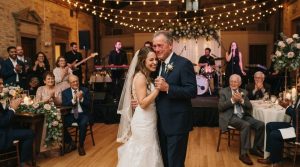
A father-daughter dance doesn’t need one person’s perfect song; it needs a choice you can both feel good about. If your tastes differ, start with a classic you share, then consider whether its lyrics and live arrangement suit the moment. Give the band advance notice of your request so it has time to prepare.
It’s normal for one of you to want a deeply sentimental ballad while the other prefers a familiar classic. The right emotional father-daughter dance songs for a live band balance your tastes and suit the way you want to dance.
This guide will help you find common ground, explore heartfelt and classic song ideas, and plan a choreographed section or a surprise switch to an upbeat tune. You’ll also learn why the version you rehearse to matters when a band performs the song live, so your moment feels personal and runs smoothly.
Key Takeaways
- Choose a song by comparing what matters to both of you: meaningful lyrics, a familiar sound, and a feel that suits how you want to dance.
- For a choreographed routine, rehearse to the same version the band will perform, since tempo and feel can shape your steps.
- Share song requests with the band in advance so it has more time to prepare the arrangement.
- Make a slow, sentimental opening your own, then consider a switch to an upbeat song for a lively finish.
- Explore heartfelt choices and enduring classics to find a song that feels personal without requiring you to agree on the same style at first.
1. Adding a choreographed section or surprise song switch
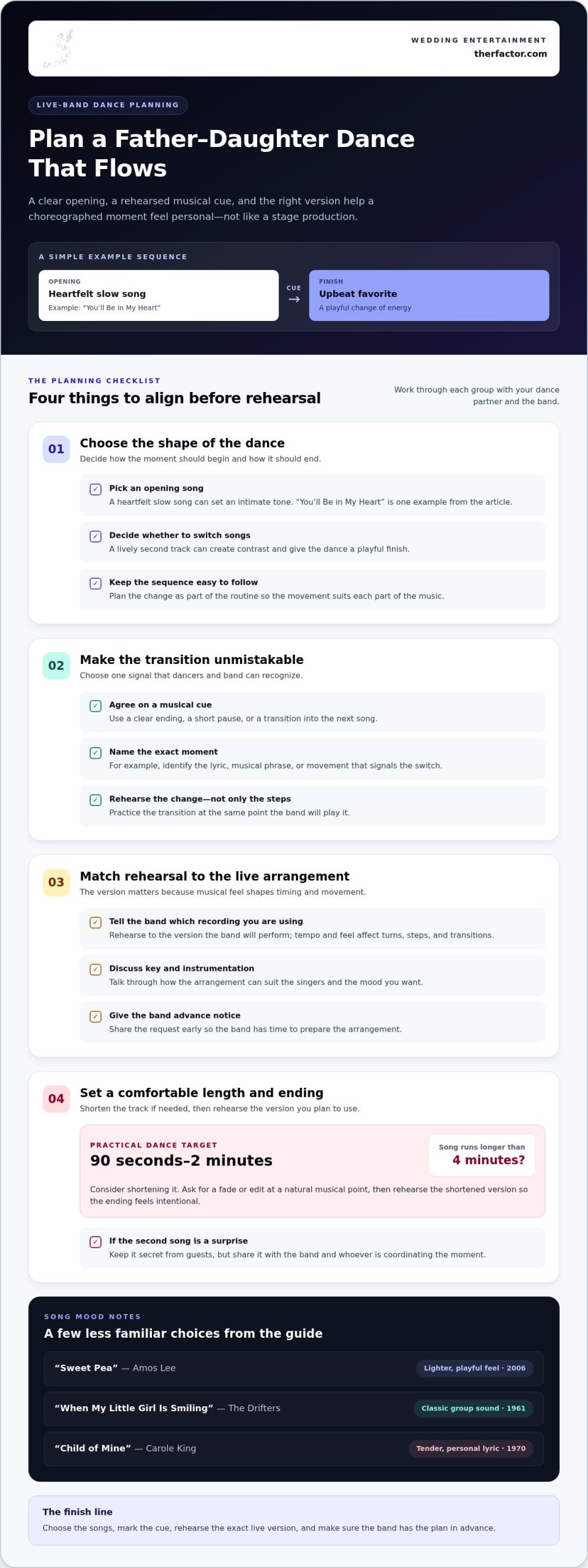
A simple sequence keeps a choreographed father-daughter dance personal without making it feel like a stage production. Choose the opening song, mark the moment for the switch, and decide how you’ll move into the next track. For example, begin with Phil Collins’s “You’ll Be in My Heart,” then shift to an upbeat favorite for a playful finish.
Tell the band which recording or arrangement you’re rehearsing to. A song’s tempo and feel shape the timing of turns, steps, and transitions. The key and instrumentation matter too, so discuss how the arrangement can suit the singers and the mood you want. A stripped-back opening can feel intimate, while fuller instrumentation can make an upbeat switch more distinct.
Keep the sequence easy to follow. Mark the change with a musical cue, such as a clear ending, a short pause, or a transition into the next song. Rehearse that exact moment, not just the steps. If “You’ll Be in My Heart” opens the dance, agree on which lyric, musical phrase, or movement signals the switch. Give the band advance notice so it has time to prepare the arrangement.
For a less familiar choice, consider these songs and their distinct moods:
- “Sweet Pea” by Amos Lee, released in 2006, can bring a lighter, playful feel.
- “When My Little Girl Is Smiling,” recorded by The Drifters in 1961, offers a classic group-sound option.
- “Child of Mine,” released by Carole King in 1970, keeps the focus on a tender, personal lyric.
Decide the dance length before rehearsing. A practical target is 90 seconds to 2 minutes; consider shortening a song that runs longer than four minutes. Ask for a fade or edit at a natural musical point, then rehearse the shortened version so the ending feels intentional.
What if we want a surprise switch? Keep the second song secret from guests, but share it with the band and whoever is coordinating the moment. “You’ll Be in My Heart” followed by a lively track creates contrast while preserving the emotional opening.
Does the band need the exact version? Yes. Rehearse to the version the band will perform, because tempo and feel affect choreography. Which song works best? Choose one that suits your relationship and planned movement, whether it’s the sentimental “You’ll Be in My Heart” or the less expected “Sweet Pea.”
A father-daughter dance can begin with a heartfelt slow song and switch halfway through to an upbeat tune. Plan the change as part of the routine, so the shift in energy feels intentional and the movement suits each part of the music. Keep the sequence clear for the dancers and the band.
Tell the band which version of the song you’re rehearsing to, since tempo and feel affect the routine. Rehearse to the version the band will perform, including the transition into the upbeat section. Agreeing on the musical change in advance helps the dancers and band follow the same plan while preserving the heartfelt opening.
2. Choosing a song both father and daughter like
Start with a shared memory, not a genre. One of you may prefer country, while the other reaches for pop or soul. Each of you can name a song that feels personal, then explain what makes it meaningful. A song with an affectionate tone can be a useful starting point if you both connect with it.
Next, compare the lyrics and mood together. Listen to each suggestion from beginning to end, rather than judging it by its title or chorus. Paul Simon’s “Father and Daughter,” released as a single in 2002, offers an explicit family connection. “The Best Day,” written by Taylor Swift for her 2008 album Fearless and dedicated to her parents, may appeal to a daughter who wants a more contemporary perspective.
For a live wedding band, choose a song with a melody that still feels recognizable when performed by live singers and instruments. “What a Wonderful World” may be worth considering if you both enjoy its relaxed feel. “How Sweet It Is (To Be Loved By You)” offers another possibility: Marvin Gaye originally recorded it in 1964, and James Taylor’s version became a hit in 1975. Compare the recordings you both enjoy, since their vocal style and energy can shape the live arrangement.
Use these steps to settle on one choice:
- Share a short list: Each person chooses two songs, such as “Father and Daughter” and “What a Wonderful World.”
- Listen for the same qualities: Identify the lyric, melody, or mood you both like.
- Try the dance feel: Move to each recording and notice which one feels comfortable together.
- Make the final pick together: Choose the song you can both imagine hearing on the wedding day.
If your tastes still differ, look for a bridge between them. A daughter drawn to modern storytelling might consider “The Best Day,” while a father who prefers a familiar standard may connect with Louis Armstrong. You don’t need identical musical tastes; you need a song whose meaning makes sense to both of you. Emotional father-daughter dance songs with a live band work best when the choice reflects that shared connection.
Should the song be a traditional ballad? No. “I Got You Babe,” released by Sonny and Cher in 1965, is a classic pop alternative if its duet feel suits your relationship. What if one of you dislikes the lyrics? Return to your shortlist and choose the track whose words and sound both feel right. For couples planning live wedding entertainment, a shared choice gives the band a clear musical direction.
Once you’ve chosen a song, give the live band advance notice so it has time to prepare an arrangement. If the track runs longer than four minutes, consider shortening it for the dance. For a choreographed dance, tell the band which version you’re rehearsing to, since differences in tempo and feel can affect the routine. Sharing these details helps the band prepare for the song and performance you have chosen.
3. Emotional and sentimental song choices
A sentimental song works best when its meaning fits your relationship, not just the wedding tradition. Stevie Wonder’s “Isn’t She Lovely” was written specifically for the father-daughter dance moment. Paul Simon’s “Father and Daughter,” released as a single in 2002, states its family connection directly. Compare the lyrics and the musical mood, then choose the song that feels sincere to both of you.
For a deeply reflective choice, consider the story behind the song. Luther Vandross released “Dance With My Father” in 2003 as a tribute to his late father. Its theme of remembering a parent can feel especially personal for families with a similar experience. Listen to the full lyric together before choosing it, and consider whether its emotional weight suits the tone you want for the dance.
Contemporary and classic options can both carry a personal message. Taylor Swift wrote “The Best Day” for her 2008 album Fearless and dedicated it to her parents. Carole King’s “Child of Mine,” released in 1970, offers a different era and songwriting style. Try comparing one newer choice with one older favorite. Notice which song’s perspective, lyrics, and melody feel closest to your shared memories.
Country songs often put the parent-child relationship at the center. Bob Carlisle wrote “Butterfly Kisses” for his daughter’s 16th birthday; the song became a major US chart hit and won a Grammy for Best Country Song. Tim McGraw wrote “My Little Girl” in 2006 to express his love for his daughter. These choices suit families who connect with country storytelling and direct expressions of affection.
Not every meaningful dance needs a slow, solemn ballad. A lighter song can express warmth through its energy and make the moment feel relaxed. If you prefer an upbeat choice, compare the rhythm and lyrics of familiar favorites, then decide whether you want to dance closely, sway, or move more freely. Keep the emotional message intact, even when the sound is playful.
Use this short process to narrow your choices:
- Choose a feeling: Decide whether you want tenderness, gratitude, remembrance, or joy.
- Read the lyrics: Check that the song’s story matches your relationship.
- Compare styles: Pair a country song like “My Little Girl” with a classic such as “Child of Mine.”
- Listen together: Choose the track that feels natural for both of you, not simply the one with the most emotional reputation.
A country ballad, a contemporary song, or a cheerful favorite can all create a heartfelt father-daughter dance. The strongest choice is the one whose lyrics and feeling belong to your relationship.
4. Classic father-daughter dance songs
A classic can give the dance a familiar melody without requiring a trendy choice. Start by deciding what “classic” means to your family: a song from your parents’ generation, a track you grew up hearing, or a standard you both recognize. Carole King’s “Child of Mine,” released in 1970, is one option for a tender, direct message. Compare its lyrics with the memories you want the dance to bring forward.
For a more reflective mood, consider Luther Vandross’s “Dance With My Father,” released in 2003 as a tribute to his late father. Its meaning may resonate with families who want to honor a parent’s memory. Tim McGraw’s “My Little Girl,” written in 2006 to express his love for his daughter, offers another personal direction. Read the lyrics together and choose the song whose point of view fits your relationship.
“Butterfly Kisses” is another enduring choice. Bob Carlisle wrote it for his daughter’s 16th birthday, and the song became a major hit on the US charts and won a Grammy for Best Country Song. Its specific family story can make it appealing, but the central question is whether its words feel true to you. A familiar title alone doesn’t make a song the right fit.
Classic choices can also sound warm or uplifting rather than solemn. Louis Armstrong released “What a Wonderful World” in 1968, while George Harrison wrote “Here Comes the Sun” in 1969. Compare the emotional tone: Armstrong’s song expresses wonder, while Harrison’s offers a brighter sense of hope. Listen to each from the opening through the ending, then consider which melody feels natural for a shared dance.
- For a heartfelt country choice: Compare “Butterfly Kisses” with Tim McGraw’s “My Little Girl.”
- For a reflective tribute: Consider “Dance With My Father” and its connection to remembrance.
- For a gentle classic: Try Carole King’s “Child of Mine” or Louis Armstrong’s “What a Wonderful World.”
- For a brighter mood: Listen to “Here Comes the Sun” and decide whether its hopeful tone fits.
Before settling on a live version, share the exact song and recording you prefer with the band. Classic recordings can differ in tempo, vocal phrasing, and instrumental feel, so those details help shape the arrangement. Ask for a rendition that preserves the melody and mood you chose. Then listen to the proposed version together and confirm that the lyrics remain clear. For a classic father-daughter dance, the best pick is the one whose meaning still feels personal when the music begins.
5. What are the best emotional father-daughter dance songs for a wedding?
The best choice depends on the feeling you want the dance to carry. For a direct father-daughter message, consider Paul Simon’s “Father and Daughter,” released as a single in 2002. Stevie Wonder’s “Isn’t She Lovely” was written specifically for the father-daughter dance moment. Both make their family connection clear, but their sound and mood differ. Listen together and choose the one that feels natural for your relationship.
For a reflective tribute, Luther Vandross’s “Dance With My Father” was released in 2003 in honor of his late father. It may suit a dance centered on remembrance. If you want a tender song with a country storytelling style, consider “Butterfly Kisses.” Bob Carlisle wrote it for his daughter’s 16th birthday, and it became a major US chart hit and won a Grammy for Best Country Song.
A classic can feel emotional without focusing on loss or nostalgia. Louis Armstrong released “What a Wonderful World” in 1968, giving families a familiar song with a warm, grateful mood. Carole King’s “Child of Mine,” released in 1970, offers another classic option. For a brighter, more contemporary soundtrack connection, Phil Collins’s “You’ll Be in My Heart” appeared on the Tarzan soundtrack in 1999. Match the song’s feeling to the atmosphere you want, rather than choosing by reputation alone.
Use this shortlist by mood, then listen to each complete recording before deciding:
- Clear father-daughter message: “Father and Daughter” or “Isn’t She Lovely.”
- Reflective tribute: “Dance With My Father.”
- Country sentiment: “Butterfly Kisses.”
- Warm classic: “What a Wonderful World” or “Child of Mine.”
- Soundtrack favorite: “You’ll Be in My Heart.”
For a live performance, share the exact song and recording you chose. A band’s arrangement can shape the tempo, instrumentation, and vocal feel, so tell the musicians what matters most: the familiar melody, a particular mood, or a clear point for the dance to end. If the recording runs longer than four minutes, consider a shorter arrangement or a fade at a natural musical point.
There’s no single best song for every family. Compare the lyrics, mood, and live arrangement, then choose the track both of you can embrace. For help shaping music around your wedding’s emotional moments, plan live wedding entertainment.
The R Factor: Wedding Entertainment
The R Factor can bring your chosen father-daughter song to life as part of its wedding entertainment in Minneapolis and St. Paul. Share the song, your preferred recording, and any planned transition or choreographed moment. These details help shape a live performance around the mood you want, whether you’ve chosen a tender classic or a slow opening with an upbeat finish.
A live band is a natural fit when you want the dance to feel personal and connected to the rest of your wedding music. The R Factor also provides corporate event music, birthday party performances, and private parties, but wedding entertainment is the right next step for planning this moment.
For live music at your wedding, contact The R Factor or visit therfactor.com.
Make the Moment Feel Like Yours
Before the wedding day, agree on the feeling you want to create. You might want guests to share a quiet, tender moment, or to smile as the dance turns playful. That intention can guide more than the song choice. It can shape how you enter the floor, where you look, and how the moment ends.
Emotional father-daughter dance songs for a live band feel more personal when the performance reflects your connection, not just a familiar recording. Tell the musicians how you want the moment to feel, and describe any transition or cue that matters. Clear direction gives your song a purpose while leaving room for the performance to feel natural.
Choose the feeling together, then let the music support it. Contact The R Factor about your dance and take the next step toward a moment that feels unmistakably yours.
Frequently Asked Questions
What if my dad and I can’t agree on a song?
Agree on the feeling first, then find a song neither of you dislikes. Each of you can name one priority, such as meaningful lyrics, a familiar sound, or a comfortable dance pace, and one dealbreaker. Compare options against those shared criteria. “Time After Time,” which reached number one in 1984, may be a familiar middle ground if its message feels right for your relationship.
Which father-daughter dance songs work well with a live wedding band?
Songs with a recognizable melody and clear vocal phrasing can translate well to live performance. Natalie Grant’s “Always Be Your Baby,” released in 2003 for the album Deeper Life, is one sentimental option to consider. For a Minneapolis-St. Paul wedding, give the band the song title and the mood you want. Its key and instrumentation choices can shape how naturally the arrangement suits the performers.
Recent Comments