

The best way to hire a band for an event depends on how that band handles bookings: contact its listed booking agent if it has one, or reach the band by email or phone if it doesn’t. A venue can help coordinate event logistics, but agree directly on who is responsible for the booking and the details. The route matters less than having the date, location, schedule, requirements, and full cost clearly documented.
It’s easy to focus on the music and leave practical details until later. That can create uncertainty about performance times, sound arrangements, or what the booking includes. Discuss those points early so the performance fits your event’s needs.
This guide explains how to compare booking routes, assess a band’s experience and music, and share the event details that shape a useful proposal. You’ll also learn what to put in writing to confirm the all-in price, coordinate arrival and soundcheck, and keep the performance schedule on track. Whether you’re planning a wedding, corporate gathering, birthday, or private party, use these steps to move from first contact to a well-organized booking.
Key Takeaways
- Choose the booking route that matches how the band handles inquiries, and make sure responsibilities are clear when a venue is involved.
- Use event type, live performance examples, and musical fit to narrow your shortlist before making a decision.
- Build the budget around a written breakdown of costs, not just the performance fee.
- Put the date, location, performance times, sound needs, and special requests into the booking agreement.
- Coordinate arrival, soundcheck, and the event-day schedule so the band and venue work from the same plan.
Will musicians and bands do a private concert or performance?
Yes. Bands and musicians can perform at private parties, weddings, and corporate events. Start by matching the act to your event, then confirm the booking details through an official channel.
Research and Vet Local Bands
Find local bands whose live repertoire suits your event, then compare recent performance videos, setlists, and reviews. Shortlist 3 to 5 bands, and look for recent footage from real events as well as polished promotional clips. For a wedding, check whether the band’s setlist fits both the reception and any quieter moments. For a corporate event, prioritize examples that match its formality and audience.
Contact Bands Through Official Channels
Contact a band through its listed booking agent when it has one; otherwise, use its official email or phone number. Include the event date, location, type, and budget in your first message. Use the band’s official channel rather than an unverified social profile, and keep booking discussions in writing. This gives both sides a clear record of the request and response.
- Step 1: Match the act to the occasion. Decide whether you want live music for a wedding, corporate event, birthday, or private party. Consider the event’s schedule and atmosphere. A band with experience at similar events can better understand cues such as a reception entrance, a short presentation, or a change in energy after dinner.
- Step 2: Compare evidence, not just descriptions. Review recent live video, setlists, and feedback from people who attended performances. Candid footage from a real wedding or company gathering can show how the band interacts with guests. If possible, see the band perform live. Look for consistent sound and stage presence, not only a single impressive clip.
- Step 3: Choose the format that fits your priorities. A DJ or solo musician may involve fewer performers and a simpler setup, while a band’s quote reflects its lineup and production needs. Costs depend on factors such as the number of performers, equipment, travel, and performance schedule. Compare what each option contributes to the event, rather than judging by format alone.
- Step 4: Send a focused booking inquiry. Share the event type, date, venue location, and your budget range. Add the expected performance window and any special requests, such as a particular song or quieter music during dinner. These details help the band assess whether its musical style and event experience align with your plans.
- Step 5: Review the response before moving forward. Compare each band’s proposed music, lineup, and performance approach against your original needs. Popular bands may be booked several months to a year or more in advance for peak spring, summer, and fall Saturdays. If your date falls in that period, begin your shortlist early and keep the event details consistent in each inquiry.
Coordinating arrival, soundcheck, and performance schedule
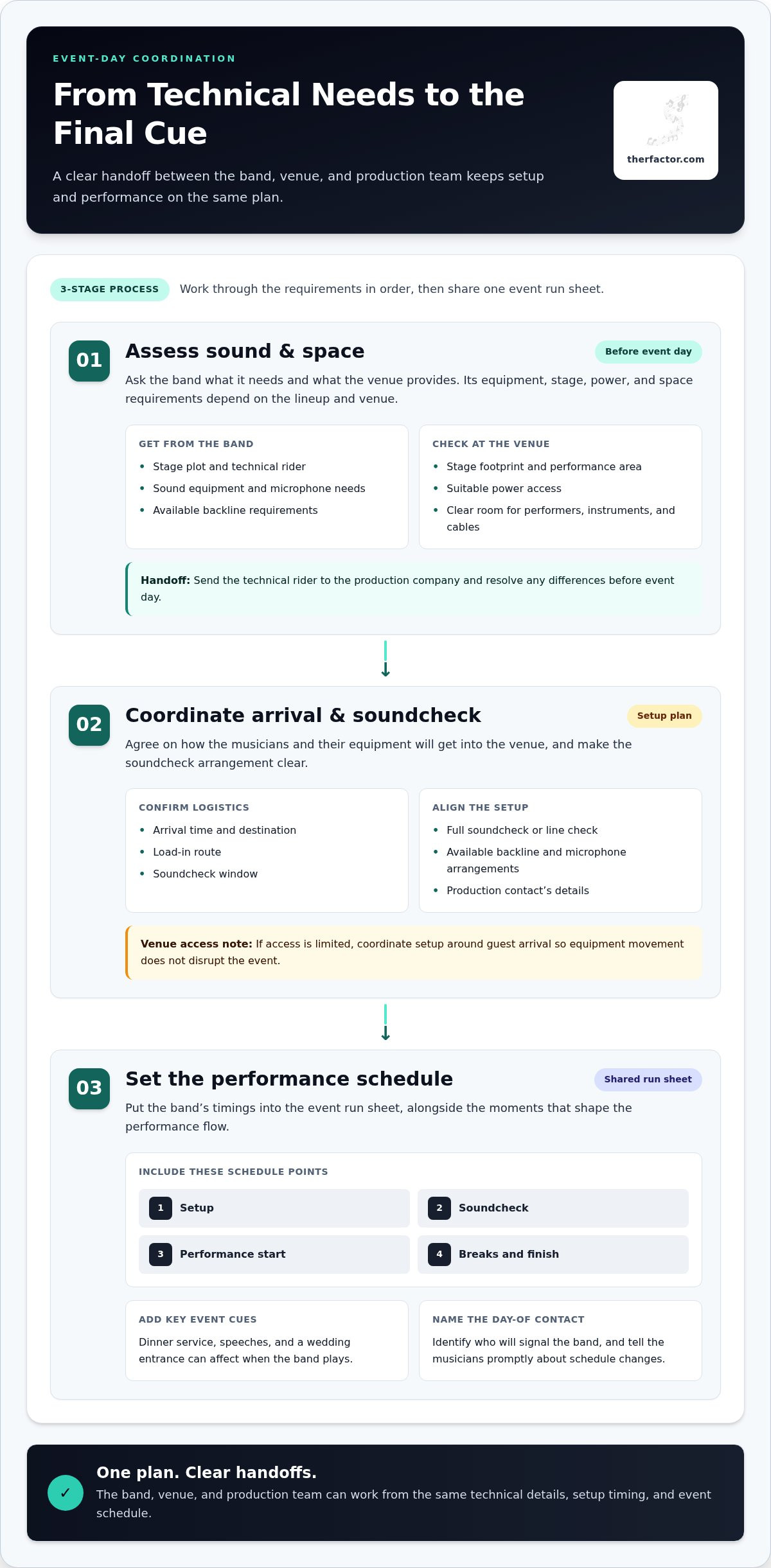
A band’s sound equipment, stage, power, and space needs depend on its lineup and the venue. Ask for its stage plot and technical rider, then share them with the production company.
-
Assess Sound and Space Requirements
Ask the band what sound equipment it needs, what the venue provides, and whether it brings its own microphones. Compare its stage plot with the available stage footprint and performance area. Confirm suitable power access and clear space for instruments, performers, and cables. Send the technical rider to the production company, and resolve differences before event day.
-
Coordinate Arrival and Soundcheck
Agree on the band’s arrival time, destination, load-in route, and soundcheck window. Tell the musicians whether they’ll have a full soundcheck or a line check, and describe the available backline. Share microphone arrangements and the production contact’s details. For a private performance in a room with limited access, coordinate setup around guest arrival so equipment movement doesn’t disrupt the event.
-
Set the Performance Schedule
Build the band’s schedule into the event run sheet, with setup, soundcheck, performance start, breaks, and finish. Include key cues, such as dinner service, speeches, or a wedding entrance. Tell the band about schedule changes promptly, and identify who will give the signal on the day. Guests can then move between event moments without conflicting instructions or an unexpected pause in live music.
- Review the band’s live performance evidence alongside its logistics. Watch candid videos from real events, not only polished promotional clips. A wedding video can show how musicians respond to a room’s energy; a corporate event clip may reveal how they handle a formal program. Read reviews for specific details about punctuality, communication, and performance flow. Look for repeated, relevant observations rather than relying on one comment.
- Match the band’s experience to your event format. Ask whether it has performed at similar private concerts, corporate gatherings, or parties, and compare those examples with your venue and schedule. Discuss how the group handles a delayed start, a short changeover, or quieter music during dining. If planning a corporate gathering, explore corporate event music that suits its schedule and audience.
Setting a budget and confirming the all-in price
Set your budget before comparing proposals, then ask for a written breakdown of all costs. Location, performance duration, lineup size, and event requirements can affect a band’s quote.
-
Set a Budget and Use Budget Filters
Decide the maximum amount available for live music before searching, then use budget filters to narrow your options. Include the event’s priorities, such as a larger lineup or a longer performance, so the filter reflects what matters. For a corporate event, reserve room for other production needs; for a birthday, prioritize the music and schedule guests will experience.
-
Consider Factors That Affect Band Prices
Give the band the event location, performance duration, and requested lineup when asking for a quote. Travel can affect the total, while a longer schedule or more musicians changes the scope of the booking. Sound and production requirements, meal arrangements, and accommodations can also shape the proposal. Compare like with like: a different lineup or performance window is not the same package.
-
Confirm the All-In Price
Ask for a written breakdown that identifies the performance fee and every additional cost, including travel, equipment, meals, or accommodations where applicable. The price depends on the booking and is provided after a quote request. Check that the contract records the agreed total, payment terms, any required non-refundable deposit, and what happens if event details change.
Use these steps to make each quote comparable before signing:
- Define the event scope. State the date, venue location, performance duration, and lineup you’re considering. Add special requests that could affect preparation or the schedule. A band can’t price the same scope if one inquiry asks for a short reception set and another describes music throughout the evening.
- Compare the same requirements. Send each shortlisted band the same event details and budget range. Compare the proposed lineup, performance schedule, travel, and production requirements alongside the total. A lower quote may reflect a different setup, so identify what each proposal covers before deciding.
- Read the contract line by line. Confirm the date, location, exact performance times, payment terms, cost breakdown, and deposit terms. Make sure the written agreement matches the proposal, especially if you changed the schedule or requested a different lineup during hiring.
- Record changes in writing. If the venue, performance duration, or lineup changes, ask for an updated breakdown and contract. Keep the final version with your event records so the planner, venue, and band share the same agreed scope and all-in price.
Subcategories and music genres
Choose music that fits the event’s audience, atmosphere, and schedule. Compare samples and discuss volume, song requests, and musicians’ meal arrangements before finalizing the entertainment.
In the United States, public performances of songs require a license under copyright law. Local governments may regulate amplified sound, and some cities require a sound device or amplified sound permit. Confirm in writing whether the venue’s performance-rights license covers your event, and include venue requirements for noise, insurance documentation, and access in your planning.
- Choose the musical format. Decide whether you want original music or covers, then compare styles that serve the event. A cover band can offer familiar songs for dancing, while a smooth jazz ensemble may suit a reception. A classical quartet can provide a more restrained sound for a ceremony or formal gathering. Match the format to what guests will be doing.
- Listen to samples with the event in mind. Review a band’s setlist and live recordings, not just its genre label. Notice how it handles transitions, vocals, and different energy levels. For a wedding reception, consider whether the samples move naturally from dinner music to dancing. For a corporate event, assess whether the group’s sound complements conversation and scheduled remarks.
- Describe the room’s volume needs. Tell the musicians when you want energetic music and when guests need to hear one another. For example, request lower volume during dinner, then a fuller sound after speeches. Discuss how the venue’s layout and event schedule affect volume. Put the agreed approach in writing, including any sound restrictions supplied by the venue.
- Discuss requests and repertoire boundaries. Ask whether the band accepts song requests or can learn a specific song. Share essential selections and any songs or styles you want avoided. A short priority list gives musicians direction without dictating every song. Make sure the band understands which moments need particular music, such as a first dance or a corporate award presentation.
- Set meal and hospitality expectations. Discuss food arrangements during booking and record in the contract whether musicians will receive a meal. Coordinate meal timing with the performance schedule, so musicians aren’t expected to eat during a set. If the band has a hospitality rider, providing one or two requested items can help welcome the performers without complicating event catering.
- Settle venue permissions before event day. Ask the venue whether its performance-rights license covers the event, and get the answer in writing. Check local amplified-sound rules and whether the city requires a sound permit. If the venue requires insurance documents or imposes noise limits, include those requirements in the event plan and share them with the band.
Discussing event details with the band
For peak spring, summer, and fall Saturdays, popular bands may be booked several months to a year or more ahead. Before booking, discuss your date, location, schedule, music needs, setup, payment terms, and contingency plans, then record agreements in the contract.
- Share the essential event details first. Give the band the date, venue location, event type, and budget in your initial inquiry. Add the expected guest experience, such as a wedding reception with dinner and dancing or a corporate event with scheduled remarks. Clear context helps the band shape a useful proposal rather than guess at your needs.
- Ask focused questions before you book. Ask whether the band is available, what lineup and performance format it proposes, and whether it accepts song requests. Discuss its setup requirements, sound and lighting needs, and whether the band or venue provides sound equipment. Ask how it handles schedule changes and unexpected interruptions, then include agreed contingency plans in the contract.
- Put the exact engagement details in writing. Make sure the contract states the event’s date, location, and exact performance times. Specify setup requirements and payment terms, including any deposit and when remaining payment is due. A written record helps prevent different assumptions about whether the booked time includes setup, breaks, or a final performance.
- Describe what makes your event different. Share details that affect the musicians’ experience, including sound and lighting arrangements, venue access, and hospitality. Tell the band about unusual room layouts, restricted load-in routes, or a tight changeover between event moments. For example, a corporate program with speeches between sets needs different cues than an uninterrupted reception.
- Agree on guest requests and hospitality. Discuss special songs, volume preferences, food, and accommodations while negotiating the booking. If musicians will receive a meal, state that clearly in the contract and coordinate its timing with the performance schedule. You can also discuss one or two guest-list spots per band member if that suits your event plan.
- Align everyone on the final plan. Share the current schedule and venue details with the band and the person coordinating event-day decisions. Name who will communicate timing changes and give performance cues. If a date or venue detail changes after signing, update the written agreement so the band and organizer work from the same plan.
Use these details to make the conversation practical and the agreement precise. Share your event details to discuss music for your corporate event.
The R Factor: Wedding Entertainment
The R Factor provides Wedding Entertainment with live cover-band music for couples planning a reception or celebration. A live band can bring familiar songs to key moments, from guest arrival through dancing, while the music selection and schedule reflect the event’s plans. The R Factor also performs for corporate events, birthday parties, and private parties, making it a relevant option when you want live music for one of these occasions.
Share your event type, date, location, and musical preferences with The R Factor to start a conversation about the performance. For a wedding, include the reception schedule and any special song requests.
Contact The R Factor to discuss your event.
Shape the Sound of Your Event
The strongest live-music choice reflects the experience you want guests to have. Picture the event from their perspective: their first impression on arrival, the atmosphere during conversation, and the energy you want when the room opens up. That vision gives your planning a clear direction. When considering how to hire a band for an event, start with the experience you want to create, then discuss how the music and schedule can support it.
The R Factor provides live music for weddings, corporate events, birthday parties, and private celebrations in Minneapolis and St. Paul. Share the occasion, your schedule, and the musical atmosphere you have in mind to start planning a performance that fits.
Take the next step and contact The R Factor to discuss music for your event. Bring your ideas, and start shaping an occasion that feels distinctly yours.
Frequently Asked Questions
Booking Direct, Through an Agency, or Through Your Venue: Which is the Best Way?
Booking directly is straightforward when the band handles inquiries itself. If it lists a booking agent, contact that agent to discuss the engagement. A venue may help coordinate logistics, but clarify whether it is handling the booking or only providing event information. Whichever route you use, keep the agreed performance details and payment terms in a written contract, with one person responsible for communicating changes.
How to hire a band for a wedding?
Start by matching the band’s music and wedding experience to the atmosphere you want, then plan how live music fits the day. The R Factor’s wedding performance options include ceremonies, cocktail hours, and receptions. Its standard quote is for a 4-hour event, with a recommended schedule of 3 sets of 1 hour 10 minutes and two 20-minute breaks. Plan breaks into the reception timeline and confirm the performance schedule with the band.
What types of events can I book a famous musician, singer, or band for?
Live bands can perform at weddings, corporate events, birthday parties, private gatherings, and other special occasions. The right fit depends on the audience, event format, and musical atmosphere. In Minneapolis and St. Paul, The R Factor performs at weddings, corporate events, birthday celebrations, and private parties. Its cover-band repertoire offers familiar songs for a lively, audience-engaging show.
How do I find and compare bands for an event near me?
Search using your city and event type, such as “Minneapolis wedding band” or “St. Paul corporate event music.” Review local venue event recaps and recent audience feedback, then compare the bands’ setlists and live examples. Shortlist 3 to 5 options with music that suits your event. For each, consider travel to your venue, the proposed lineup, and whether its performance style fits your schedule.
How much does it cost to hire a live band for an event?
A band’s price depends on the event date, location, performance duration, lineup, travel, and production needs. The total is provided after a quote request. Give the band the same details you used to set your event budget, then compare written cost breakdowns rather than headline fees. Check that the proposal accounts for the agreed performance schedule and any travel or hospitality arrangements relevant to your booking.
What should a band contract include, including deposit and cancellation terms?
A band contract should state the event date, location, exact performance times, setup requirements, payment terms, and contingency plans. It should also explain whether a deposit is required and whether it is non-refundable. Read the cancellation terms carefully, including what happens if either party cancels or the event changes. Keep the final agreement and any written amendments together, so the organizer and band have the same record.
How do I check a band’s experience, reviews, repertoire, and live performance quality?
Look for examples from events like yours, then compare live recordings with the band’s setlist and recent reviews. Check whether feedback mentions details relevant to your plans, such as pacing or audience interaction. The R Factor’s catalog includes over 750 songs, and it recommends selecting 50-60 for an event. Use that selection process to identify songs and styles that reflect your guests and occasion.
How do I choose a band that fits my event, audience, venue, and music preferences?
To decide how to hire a band for an event, start with the experience you want guests to have. Consider whether they’ll be dancing, dining, or listening to a formal program, then match the repertoire and volume to those moments. Compare the venue’s performance space and schedule with the band’s proposed lineup and setup needs. A cover band, smooth jazz ensemble, or classical quartet creates a different atmosphere.
Recent Comments