
Last Updated: November 21, 2026
Quick Summary
The average live wedding band costs about $4,500 while the average wedding DJ runs about $1,800, making the band roughly two and a half times the price. That band vs DJ cost gap reflects different products: you pay for multiple performers, live arrangement, and often production with a band, while a DJ runs recorded music from a laptop and sound system. Normalize every quote to an all-in, tax-included number for your full timeline before ranking them.
- Band size is the biggest price lever, since many groups charge per member.
- A four-hour DJ booking covers a typical dinner-and-dancing reception, and longer receptions incur an overtime rate.
- Many band contracts require a hot meal and break room for each performer.
- Bands often bill overtime per musician per hour, so an extra hour can cost several times a DJ’s overtime rate.
- Under 75 guests, a duo or trio suits the room and a full band can overwhelm the space.
Table of Contents
- Wedding Band vs DJ Cost Comparison: The Numbers Side by Side
- Wedding Band Cost: What Drives the Price Tag
- Average Cost of a Wedding DJ for 4 Hours
- Average Cost of a Wedding DJ for 6 Hours
- Wedding DJ Cost Per Hour: Breaking Down the Rate
- What Band and DJ Packages Actually Include
- Pros and Cons: Atmosphere, Music Variety, and Guest Experience
- Total Entertainment Cost by Reception Timeline and Guest Count
- Frequently Asked Questions
Wedding Band vs DJ Cost Comparison: The Numbers Side by Side
Live music usually costs meaningfully more than a DJ, and the gap is wider than most couples expect.
At The R Factor, we have played weddings and corporate events for over 30 years.
A wedding band vs DJ cost comparison is a side-by-side look at what a live band and a wedding DJ charge for the same reception, including what each price covers.
Wedding Band Cost: What Drives the Price Tag
A live wedding band typically costs several times what a DJ charges, and the price reflects headcount more than anything else. Every additional musician is another player to pay, rehearse, feed, and move.
Band size is the biggest lever. A soloist or duo sits at the low end. A full band with horns, multiple vocalists, and a rhythm section sits at the top.
Band Size, Travel, and Production Fees
Three line items push a band quote up or down:
- Band size: more players means a higher base fee, and many groups charge per member.
- Travel: regional acts charge mileage and lodging for events outside their home area.
- Production: sound, lighting, staging, and crew are sometimes bundled and sometimes billed separately.
Ask every band whether their quote includes production or adds it later. A quote that looks competitive can climb once lights and a sound engineer are added. For a detailed look at how packages are structured, see our wedding band pricing and packages guide.
Average Cost of a Wedding DJ for 4 Hours
Four hours covers a typical dinner-and-dancing reception: cocktail hour overlap, introductions, first dance, dinner, and two to three hours of open dancing. Longer receptions incur an overtime rate.
The lower price does not mean lower effort. A good DJ arrives early, sets up, reads the room, and manages the timeline. What you save is paying five to ten performers instead of one.
Average Cost of a Wedding DJ for 6 Hours
A six-hour DJ booking usually costs more than a four-hour one, but not double. Many DJs price the extra two hours as an add-on rather than a second full rate.
Six hours covers a longer reception with cocktail hour, full dinner, and an extended dance block, plus ceremonies where the DJ handles ceremony music and microphone setup.
Watch out: some DJs quote a low base rate and then charge for ceremony sound, uplighting, or extra microphones separately.
Wedding DJ Cost Per Hour: Breaking Down the Rate
The wedding DJ cost per hour looks high when you divide the total by performance time, and that math is misleading. A DJ’s fee covers setup, travel, equipment, planning calls, and teardown, not just the hours the music plays.
Use cost per hour only to compare DJs against each other, not a DJ against a band. Bands carry a different cost structure entirely.
What Band and DJ Packages Actually Include
Packages differ more than prices do, and this is where most comparisons fall apart. Two quotes at the same headline price can cover very different amounts of work, so the only fair comparison is line by line. Below is the itemization most couples never ask for.
| Line item | Typical Band Package | Typical DJ Package |
|---|---|---|
| Performers | 4-12 musicians, priced per member | 1 DJ, sometimes a separate MC |
| Performance hours | 3-4 sets with breaks, or continuous coverage at a premium | Continuous, typically 4-6 hours |
| Sound system | Usually included; larger rooms may need a rental upgrade | Usually included |
| Lighting | Often included or an add-on; uplighting frequently separate | Often an add-on |
| MC services | Variable; some bands announce, some do not | Common, sometimes a separate fee |
| Setup and teardown | Included | Included |
| Travel | Mileage and lodging common outside home area | Mileage common outside home area |
| Meals and breaks | Often contractually required for each performer | Sometimes required for long events |
| Overtime | Hourly add-on, often billed per musician | Hourly add-on |
| Taxes and gratuity | May be added on top of the quoted fee | May be added on top of the quoted fee |
Sound, Lighting, and MC Services
Production is the line item couples miss. A band that does not means hiring a separate production company, and that second quote can erase the apparent savings of a cheaper band.
At The R Factor, our full-service production includes sound, lights, and road crew.
MC duties are the other variable. Some DJs announce introductions and toasts as part of the fee; some bands do, some do not.
The Line Items That Quietly Inflate a Quote
Four charges show up after the headline number and are easy to miss:
- Meals and breaks. Many band contracts require a hot meal and a break room for each performer. On a 10-piece group that is a real catering line, and it belongs in your total.
- Overtime. Bands often bill overtime per musician per hour, so an extra hour can cost several times a DJ’s overtime rate. Ask for the overtime rate in writing before you compare base fees.
- Travel and lodging. Regional acts charge mileage and, for distant events, overnight lodging. A DJ usually travels lighter and cheaper.
- Taxes and gratuity. Some quotes are pre-tax and pre-gratuity. Normalize every quote to an all-in, tax-included number before you rank them.
Watch out: a band quote that looks competitive can climb once lights, a sound engineer, meals, and overtime are added, so ask for the all-in number for your full timeline rather than the base performance fee.
How to Normalize Two Quotes
Put every quote on the same page before you decide. Ask each vendor for a written breakdown covering setup, performance hours, overtime rate, travel, production, meals, taxes, and gratuity, then compare all-in totals for the same coverage window. A band at a higher base price with production and MC included can land closer to a DJ’s all-in number than the averages suggest, and a cheap DJ with add-on lighting and ceremony sound can close the gap from the other direction.
Pros and Cons: Atmosphere, Music Variety, and Guest Experience
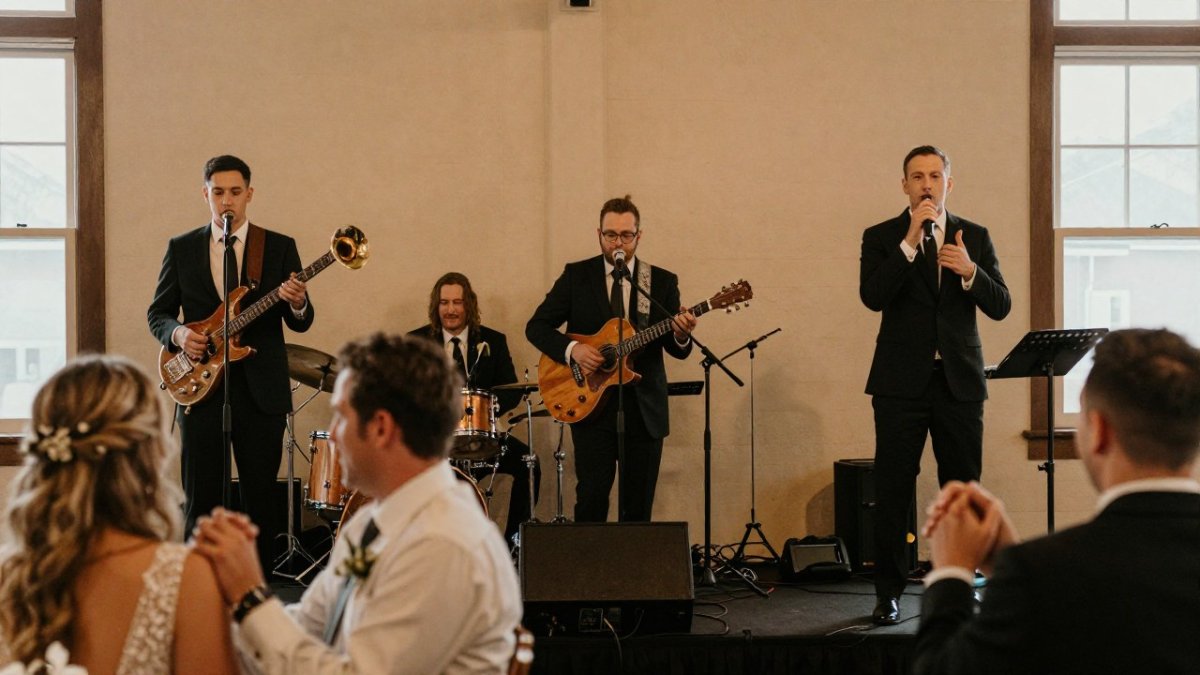
A live band wins on atmosphere and energy. A DJ wins on music variety and flexibility. Neither wins outright, and the right pick depends on what your guests will remember.
Live band pros:
- A live show creates a shared spectacle that recorded music cannot match.
- Horn sections and multiple vocalists fill a dance floor with real volume and presence.
- A polished band reads the crowd and adjusts the set in real time.
Live band cons:
- Higher cost, driven by headcount.
- Set breaks unless the band offers continuous coverage.
- Less flexibility on obscure requests outside the catalog.
DJ pros:
- Lower cost for the same reception block.
- Near-limitless song selection and instant requests.
- Continuous music with no breaks.
DJ cons:
- Recorded music carries less visual energy than a stage full of players.
- Crowd reading depends entirely on one person’s skill.
- A weak DJ is more noticeable than a weak band, because there is nothing else to watch.
What most guides miss is that guest count changes this math. A 75-guest anniversary dinner does not need a 12-piece band, but a scaled-down six-piece group still delivers live energy.
Total Entertainment Cost by Reception Timeline and Guest Count
Most comparisons stop at the average price. The useful question is what entertainment costs for your specific timeline and guest count, because that is the number you will sign for. Total entertainment cost depends on four variables: length of coverage, guest count, whether production is bundled, and how many separate performers your timeline requires. Price the whole day, not just the dance block.
Cost by Reception Timeline
A wedding day is rarely one continuous performance block. Ceremony, cocktail hour, dinner, and dancing each need sound, and each can require a separate performer or an extra hour. The table below shows how coverage stacks up for a band versus a DJ across a typical timeline.
| Timeline segment | What a band typically covers | What a DJ typically covers | Cost driver to confirm |
|---|---|---|---|
| Ceremony (30-60 min) | Often a separate smaller ensemble or soloist | Same DJ with ceremony sound and microphones | Ceremony sound is frequently an add-on for both |
| Cocktail hour (60 min) | A duo or trio, or recorded music between sets | Same DJ running a separate playlist | A second performer adds a line item |
| Dinner (60-90 min) | Light jazz or background set, or recorded music | Continuous background music | Bands may charge a dinner set separately |
| Dancing (2-3 hours) | Full band sets with breaks | Continuous open-format block | Overtime rates differ sharply |
A short reception under four hours favors a DJ on pure efficiency, and a smaller band configuration can compete on value. A standard four-to-five-hour reception fits both options, and the gap comes down to whether you want a stage show. A long reception with a ceremony and cocktail hour is where totals diverge most, because every additional segment is another chance for a separate performer or extra hour to appear on the quote.
Cost by Guest Count
Guest count drives the band decision more than anything else, because it determines how much sound and stage the room needs and how many performers the dance floor can support.
- Under 75 guests: a duo or trio suits the room, and a full band can overwhelm the space. A DJ is the efficient choice, and a small band can still deliver live energy.
- 75-150 guests: a six-to-eight-piece group fits most rooms and dance floors. This is the range where band and DJ quotes are closest on a per-guest basis.
- 150-250 guests: a full ensemble with horns and multiple vocalists earns its price, and the sound system needs to match the room. A DJ needs a larger PA and possibly a second setup.
- Over 250 guests: production becomes the dominant cost for either option, and a band’s bundled sound and lighting can offset part of the headline gap.
A Sample All-In Comparison
To see how the variables interact, price a standard five-hour reception with a cocktail hour and 150 guests. For a band, expect the base performance fee plus a cocktail-hour set, overtime if dancing runs long, travel, meals per performer, and taxes.
Watch out: a quote built only around the dance block will look cheaper than one covering ceremony, cocktail hour, and dinner, so ask each vendor to price your full timeline before comparing totals.
Get the Written Quote That Makes the Comparison Honest
Ask each vendor for a written quote covering setup, performance, overtime, travel, production, meals, and taxes for your exact timeline and guest count. That single document makes the band vs DJ cost comparison honest, because you are comparing the same scope of work across the same hours for the same room.
The real challenge is not finding the cheapest quote. It is knowing what you are buying when the numbers look similar.
Frequently Asked Questions
Is a DJ or band cheaper for a wedding?
A DJ is consistently cheaper. Live bands generally cost substantially more than DJs. The gap comes from band size, rehearsal time, and production. A DJ needs one person and a sound system; a six- to twelve-piece band needs players, a road crew, and lighting. If budget is your deciding factor, a DJ wins on price alone.
How much does a wedding DJ cost for 4 hours?
Four-hour DJ pricing varies by vendor, date, and location, so request a written quote for your event. A four-hour block typically covers cocktail hour, dinner, and the first stretch of dancing. Shorter blocks sometimes carry a minimum fee, so ask whether your quote includes setup and teardown time or just performance hours. Get the answer in writing before you sign.
What factors affect the cost of a wedding band or DJ?
The biggest drivers are band size, travel distance, hours of coverage, and whether sound and lighting are included. A soloist or duo costs far less than a full band with a horn section. Overtime, extra hours, and venue requirements like load-in restrictions or generator power add to both options. For DJs, MC duties, ceremony music, and uplighting are common add-ons. Always request an itemized quote so you can compare like for like.
Is it better to have a band or DJ at a wedding?
It depends on what your guests will remember. A live band delivers a performance, a packed dance floor, and a memorable experience that recorded music struggles to match, especially for a high-energy reception. A DJ offers broader music variety and easier song requests. Many couples split the difference: a DJ for cocktail hour and a band for the main reception. Match the choice to your guest count, venue, and priorities rather than price alone.
How much does a wedding band cost compared with a DJ?
Band pricing generally scales with size, so a soloist or duo typically costs less than a larger ensemble with horns and full production. Travel fees, overtime, and staging requirements push the figure higher. Request a quote based on your date, guest count, and venue so the number reflects your event, not a national average.

Recent Comments