

A single technical oversight from an amateur band can leave your guests sitting in silence, regardless of how much you spent on the venue. Only 12% of couples choose a live band, yet that small group often carries the heaviest stress during the planning process. You aren’t just hiring musicians; you’re trusting a group to manage the energy of your most important day. The difference between a crowded, high-energy dance floor and a “dead” room often comes down to the specific questions to ask a wedding band before you sign the contract. Most couples focus on the setlist, but the real risks live in the technical riders, power needs, and last-minute member swaps that amateurs rarely mention.
It’s natural to feel anxious about hidden costs or whether the band can actually handle the flow of a professional event. You deserve the peace of mind that comes from working with a managed, elite ensemble rather than a loose collection of weekend players. This guide provides an expert-vetted list of 25 essential questions designed to reveal a band’s true level of professionalism. We’ll walk through the logistical must-haves and performance standards that ensure your 2026 Minneapolis or St. Paul celebration is handled with the precision and elegance it requires.
Key Takeaways
- Confirm venue compatibility early to ensure your chosen ensemble can perform at peak capacity within the specific logistical constraints of Twin Cities event spaces.
- Learn how to vet a band’s repertoire to balance timeless classics with 2026 trends while maintaining strict control over your “must-play” and “do-not-play” lists.
- Use our curated list of technical questions to ask a wedding band to prevent power failures and sound issues caused by inadequate electrical planning.
- Distinguish between fixed lineups and roster-based acts to ensure the specific vocalists and musicians you book are the ones who actually perform on your wedding day.
- Protect your investment by mastering the nuances of modern contracts, including public liability insurance requirements and updated postponement policies.
The Foundation: Essential Logistics and Availability Questions
The most talented musicians in the world are a liability if they cannot meet the basic logistical requirements of your venue. Booking your entertainment isn’t a simple transaction; it’s the start of a professional partnership. Before you dive into specific wedding music traditions or song requests, you must ensure the ensemble is available and equipped to handle your specific location. Many couples assume a “yes” on the calendar is sufficient. It isn’t. You need to understand the band’s operational capacity and how they manage their schedule to avoid being treated as just another line item on a spreadsheet.
Securing the Date and Travel Logistics
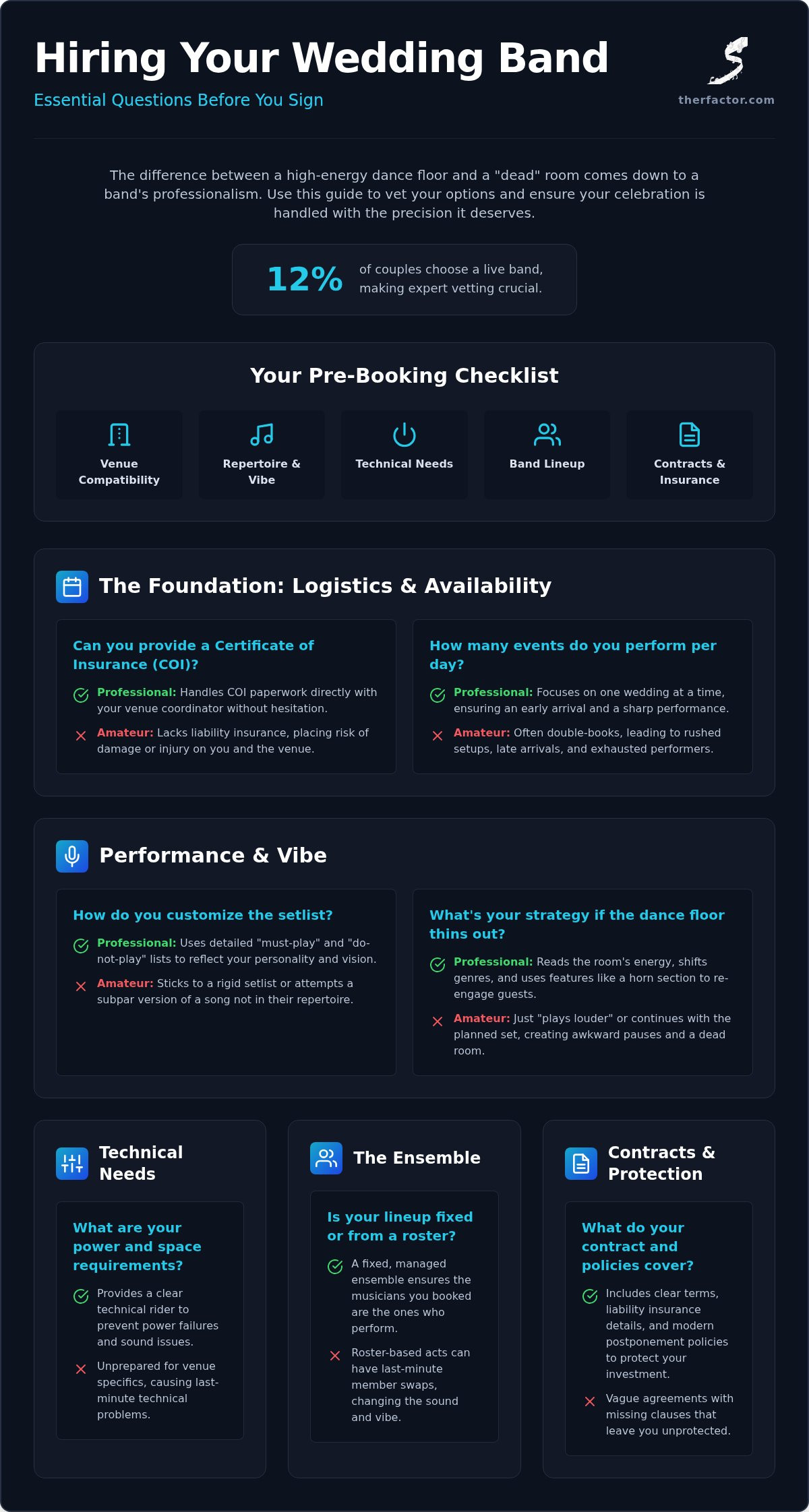
One of the most revealing questions to ask a wedding band is: “How many events do you perform per day?” Amateur acts or massive booking agencies often double-book musicians, which leads to rushed setups, late arrivals, or exhausted performers. The R Factor focuses on one wedding at a time. This singular focus ensures our 6 to 12 piece ensemble arrives early, conducts a thorough sound check, and remains sharp for your grand entrance. If your celebration takes place outside the immediate Minneapolis-St. Paul metro area, clarify the travel fees immediately. Professional groups provide transparent quotes that include mileage and lodging if necessary. Choosing a local band with a fixed management office, like Marsh Productions, offers a level of accountability that national conglomerates simply cannot match. You aren’t dealing with a faceless coordinator in a different time zone. You’re working with a Minneapolis-based team that knows the local landscape and venue staff personally.
Insurance and Professional Liability
Professionalism extends far beyond the stage. Premier Minneapolis venues such as the Aria or the Machine Shop have strict requirements for all outside vendors. They often demand a Certificate of Insurance (COI) before any equipment enters the building. Ask the band directly: “Can you provide a certificate of insurance directly to my venue coordinator?” An elite ensemble will handle this paperwork without hesitation. This distinction clearly separates a legitimate business from a hobbyist group. If a band lacks liability insurance, you could be held responsible for accidental damage to the venue or injuries on the dance floor. A professional band manages these risks internally. This allows you to focus on the celebration rather than the fine print. Additionally, clarify the booking process and “hold” policies. A reputable band should offer a clear path to secure your date, ensuring no other client can book your slot while you are finalizing the contract details.
Performance and Vibe: Reading the Room and Repertoire
A wedding band’s value isn’t measured by a static list of songs. It’s measured by their ability to adapt to the room. When considering questions to ask a wedding band, focus on how they translate a playlist into a shared experience. An elite ensemble doesn’t just play through a set; they curate a journey from the first dance to the final encore. This requires a level of musical intuition that separates seasoned professionals from weekend hobbyists.
Customizing the Setlist for Your Guests
Ask: “How do you handle requests that aren’t on your master list?” Professional bands maintain a repertoire that spans decades, from classic Motown to 2026’s top hits. However, the true test of an act is how they accommodate your specific vision. Our process involves detailed “must-play” and “do-not-play” lists to ensure the music reflects your personality. Having four distinct vocalists allows us to cover diverse genres with authentic tone and range. This versatility is a critical factor when choosing live wedding music Minneapolis couples trust. If a request doesn’t fit the band’s configuration, a pro will tell you honestly rather than attempting a subpar rendition.
Managing Energy and Floor Flow
Energy management is the band leader’s ability to read a room’s body language and adjust the tempo in real-time. Ask: “What is your strategy if the dance floor starts to thin out?” A “red flag” answer is a simple shrug or a promise to “play louder.” A professional response involves shifting genres or utilizing the “wow” factor of a full horn section and violin to re-engage guests. Transitions should be seamless, moving from a soulful ballad to a high-energy anthem without awkward pauses. You can find a comprehensive list of questions to help vet these performance nuances, but seeing a band’s versatility in action is best. Many elite groups also provide tailored music for ceremonies and cocktail hours, ensuring a consistent vibe throughout the day. If you want a celebration that feels cohesive and energetic, exploring professional entertainment options early in your planning is essential.
Technical Requirements: Power, Space, and Sound Checks
Technical failure is the fastest way to derail a perfect evening. While most couples focus on the music, the logistical infrastructure behind the performance is what ensures a seamless event. Elite ensembles operate with the precision of a touring production, requiring specific power, space, and timing to function at their peak. These aren’t just details for your planner; they are essential questions to ask a wedding band to protect the integrity of your celebration. An amateur group might assume a few wall outlets are sufficient, but a professional production requires a much more robust foundation.
Venue Compatibility in the Twin Cities
Ask: “Have you performed at our specific venue before, and what are the load-in challenges?” Every Twin Cities space, from the industrial heights of the Machine Shop to the historic elegance of the Saint Paul Hotel, presents unique technical hurdles. A professional ensemble managed by a dedicated production team will often be familiar with these layouts already. The physical footprint is a major consideration. For example, the stage size required for an 11 piece wedding band Minneapolis setup is significantly larger than a standard four-piece bar act. You must also confirm that a professional sound engineer will be on-site. At The R Factor, we never rely on the musicians to mix their own sound from the stage. A dedicated engineer ensures the balance is perfect in every corner of the room, regardless of the venue’s acoustics.
Sound Check and Setup Logistics
Ask: “How early do you arrive to ensure sound is perfect before guests enter?” A professional setup for a 6 to 12 piece band takes hours. Load-in and sound checks must be completed well before the first guest arrives to avoid the distraction of moving equipment. Power is another non-negotiable factor. High-end sound systems and lighting rigs require dedicated circuits, often multiple 20-amp lines, to prevent electrical overloads. If your venue has strict decibel limits, your band must have a strategy to maintain high energy without violating local ordinances. We prioritize energy management, which includes controlling volume levels so the music is impactful on the dance floor but allows for comfortable conversation during dinner. This level of technical oversight is what separates a professional wedding ensemble from a basic music act. It’s about providing a complex, risk-free solution that allows you to enjoy your day without worrying about a tripped breaker.
The Ensemble: Who Actually Performs on Your Wedding Day?
One of the most significant risks in the wedding industry is the “roster” band model. Many national booking agencies sell a high-end brand name but dispatch whichever freelance musicians happen to be available on your specific date. This often results in a group of strangers meeting for the first time in the venue parking lot. When evaluating your entertainment, the most vital questions to ask a wedding band involve lineup stability and chemistry. You aren’t just hiring talent; you’re hiring a team that knows how to work together to maintain the energy of the room.
Ensuring Lineup Consistency
Ask: “Will the musicians I see in your videos be the ones performing at my wedding?” A “red flag” response is any vague promise of “equivalent talent” or “professional substitutes.” An elite ensemble like The R Factor, managed by Marsh Productions since 1994, relies on a consistent core of performers who have spent years perfecting their collective sound. This long-term stability is rare in an industry filled with rotating lineups. Having four distinct vocalists, a full horn section, and a violin allows for a versatile performance that sounds like the original records. This consistency ensures the high-energy chemistry you saw in promotional materials is exactly what you experience on the dance floor. If a band cannot guarantee their core members, you are essentially paying for a rehearsal on your wedding night.
Master of Ceremonies and Event Flow
The music is only one part of a successful reception. Your band leader acts as a project manager for your reception’s timeline, ensuring every transition happens exactly when it should. Ask: “Who will be the primary MC for our grand entrance and toasts?” You need a professional who can deliver clear, elegant announcements without the “cheesy” persona of a club DJ. This individual coordinates directly with your wedding planner and caterer so that the grand entrance doesn’t happen while the kitchen is behind or guests are still at the bar. Professionalism also means having a robust contingency plan. Elite groups maintain a network of vetted alternates who have rehearsed with the ensemble. If a key member falls ill, a managed band handles the replacement seamlessly, ensuring the performance remains at a premier level. To ensure your celebration is handled by a team with this level of coordination, contact our management team to discuss your ensemble needs.
Contracts and Peace of Mind: Finalizing the Booking
The final stage of securing your entertainment is the transition from musical vision to legal reality. A professional contract serves as the blueprint for your entire reception. It protects your investment and ensures that every technical and performance detail discussed is enforceable. While amateur acts might rely on a handshake or a vague email, elite ensembles operate through established production offices. This administrative rigor is what provides true peace of mind. When you reach this stage, the specific questions to ask a wedding band should shift toward financial transparency and logistical obligations.
Financial Transparency and Overtime
Clarity in billing is a hallmark of a professional service provider. Ask: “Are there any hidden fees for sound systems, lighting, or MC services?” A comprehensive quote from a managed band like The R Factor includes these essential elements upfront. You should also prepare for the possibility of a party that exceeds your expectations. If the energy on the dance floor is too high to stop, you don’t want to negotiate rates in the middle of a celebration. Pre-negotiating overtime rates in the initial contract prevents awkward conversations on the night of the event. A written agreement managed by a professional production office, such as Marsh Productions, ensures that payment schedules for deposits and final balances are clearly defined. This structured approach eliminates the anxiety of last-minute financial surprises.
The Hospitality Rider
A high-energy performance requires significant physical effort. The hospitality rider isn’t about luxury; it’s about ensuring your performers are fueled and ready to maintain a premier level of entertainment. Ask: “What are your specific requirements for meals and a changing area?” Most professional 6 to 12 piece ensembles require a hot meal and a secure “green room” or changing space. A well-fed band delivers a noticeably higher energy performance than one left to find their own food during a short break. These requirements should be finalized early so they can be integrated into your venue’s catering plan without friction.
Finally, establish the timeline for deliverables. You need to know exactly when your song choices, floor plans, and “do-not-play” lists are due. For a 2026 wedding, most professional groups require these details at least four to six weeks before the date. This lead time allows the band leader to coordinate with your wedding planner and finalize the technical setup. Having a clear “day-of” contact person for the band ensures that any minor adjustments are handled without involving the couple. Once the contract is signed, you can step back and trust that your entertainment is in the hands of seasoned experts who have mastered the art of the wedding reception.
Secure Your 2026 Wedding Entertainment with Confidence
Choosing the right entertainment is the single most impactful decision for your reception’s atmosphere. By utilizing these specific questions to ask a wedding band, you’ve moved beyond surface-level aesthetics to evaluate technical proficiency and logistical reliability. You now understand the importance of lineup consistency, the necessity of professional sound engineering, and the protective value of a managed contract. These details ensure that your dance floor remains the focal point of the evening without the risk of technical failures or “bait and switch” lineups.
Professionalism in 2026 requires more than just musical talent; it demands a project management approach to your wedding timeline. The R Factor, managed by Marsh Productions, brings over 30 years of experience to every performance. Our flexible 6 to 12 piece ensembles include expert MC services to guide your guests through every grand entrance and toast with elegance. Book a consultation with The R Factor to discuss your 2026 wedding vision and experience the peace of mind that comes from working with a premier Minneapolis ensemble. Your celebration deserves a soundtrack that’s as flawless as the rest of your planning.
Frequently Asked Questions
Do I need to provide a stage for the wedding band?
You don’t always need to provide a stage, but a solid, level surface is mandatory for the safety of the musicians and equipment. Many Minneapolis venues like the Aria include staging in their rental. If your venue doesn’t, a 6 to 12 piece ensemble requires a clear footprint to perform effectively. We coordinate directly with your venue manager to determine if the existing space accommodates our full horn and rhythm sections safely.
How long does a wedding band typically play for?
A professional wedding band typically performs for three to four hours of actual play time. This is usually divided into three 45 minute or 60 minute sets. This structure allows for natural transitions during dinner or dessert. We manage the flow of the evening to ensure the energy peaks during the final dance sets. We also provide expert MC services to keep your timeline moving between musical performances.
Can a wedding band also play recorded music during their breaks?
Yes, we provide curated recorded music during all band breaks to ensure there is never a moment of silence. This is a standard part of our comprehensive entertainment solution. You can provide specific playlists or trust our team to select tracks that maintain the room’s energy. This transition is handled by our on-site sound engineer to ensure the volume remains consistent and professional throughout the entire reception.
What is a ‘technical rider’ and why does it matter for my wedding?
A technical rider is a document that outlines the specific power, space, and equipment requirements for a performance. For a 12-piece band, this includes details like dedicated 20-amp circuits and specific stage dimensions. It matters because it prevents technical failures and ensures the ensemble sounds its best. Reviewing this document is one of the most important questions to ask a wedding band to avoid last minute logistical issues at your venue.
Should I tip the wedding band, and if so, how much?
Tipping is never required but is a traditional way to show appreciation for exceptional service. If the ensemble delivers a high-energy performance that exceeds your expectations, a common standard is $25 to $50 per musician. You can provide this to the band leader at the end of the night. Managed groups like ours prioritize professionalism regardless of gratuities, but our performers always appreciate the personal recognition of their hard work.
Can the band learn a specific song for our first dance?
Elite ensembles will learn a specific song for your first dance or a parent dance if it isn’t already in their repertoire. We specialize in high-energy, versatile performances and want your key moments to feel authentic. We typically ask for these requests at least six weeks in advance. This gives our four vocalists and full horn section time to arrange and rehearse the song to a premier professional standard.
What happens if the venue has power limitations for a large band?
If a venue has power limitations, a professional production team will find a solution during the site visit. Large bands with high-end sound systems require multiple dedicated circuits to avoid tripping breakers. We coordinate with Minneapolis venue coordinators early in the planning process to assess electrical capacity. If the internal power is insufficient, we discuss options like portable power distribution to ensure your performance remains uninterrupted and high-energy.
How far in advance should I book a wedding band in Minneapolis?
You should book your wedding band 12 to 18 months in advance for prime dates in the Minneapolis-Saint Paul area. Popular months like October and September fill up quickly due to the high demand for premier entertainment. Securing your date early with a managed ensemble ensures you get the specific lineup you want. Waiting too long often means settling for “roster” bands that lack the chemistry and experience of a fixed professional group.
Recent Comments