
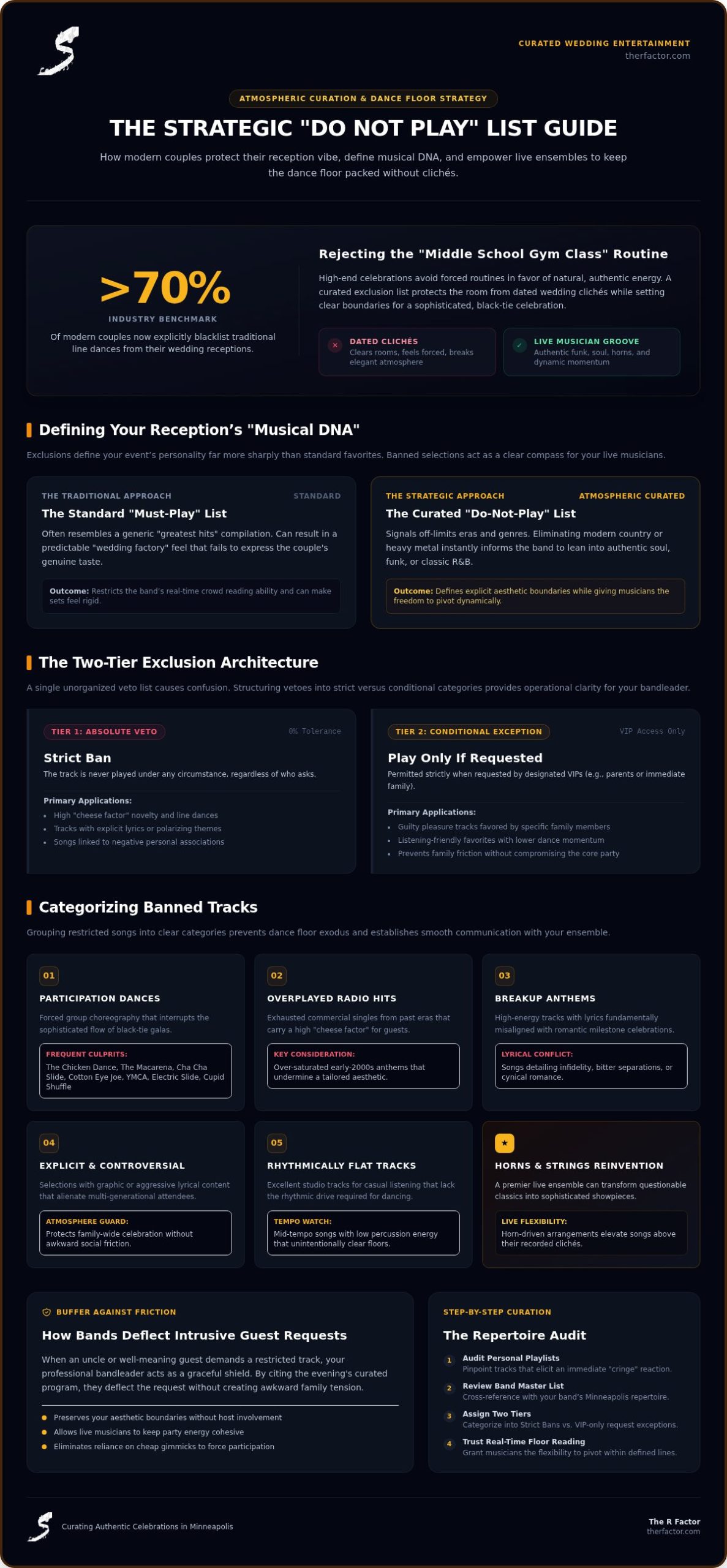
Recent industry data shows that over 70% of modern couples now explicitly blacklist traditional line dances like “The Macarena” or “The Chicken Dance.” You likely feel a similar urge to protect your reception from dated wedding clichés that feel more like a middle school gym class than a sophisticated celebration. It’s natural to worry that a restrictive do not play list for wedding band could inadvertently kill the party energy or offend a well-meaning family member. You want a night that reflects your taste. You should never have to settle for a generic playlist that relies on forced routines to fill the floor.
High-end entertainment requires a delicate balance between your personal preference and professional expertise. This guide shows you exactly how to curate your wedding music by identifying the tracks that don’t fit your vision. You’ll gain a clear framework for music communication that ensures your dance floor stays packed all night. We’ll explore how to handle guest requests with grace and why a curated list actually empowers a professional ensemble to deliver a more authentic, high-energy performance. You can take the pressure off your shoulders and trust that your celebration will flow perfectly.
Key Takeaways
- Learn how to establish clear atmospheric boundaries to prevent “cringe” moments and maintain a sophisticated tone throughout your reception.
- Discover the most effective way to categorize banned tracks, distinguishing between strict bans and songs that should only be played upon guest request.
- Understand why a professional do not play list for wedding band is a vital tool that helps live musicians read the room while respecting your unique vision.
- See how a premier ensemble featuring horns and strings can reinvent certain classics, giving you more flexibility with your musical choices.
- Get a step-by-step checklist for auditing your personal playlists against a band’s master repertoire to ensure your Minneapolis celebration feels authentic.
The Strategic Importance of a ‘Do Not Play’ List for Your Wedding
A “Do Not Play” list serves as a vital boundary for your celebration. It’s more than a simple veto; it’s a tool for atmospheric curation. For a high-end Minneapolis gala, the wrong track can shatter a sophisticated tone in seconds. Professional ensembles actually value these guidelines. They provide a graceful way for the bandleader to deflect intrusive guest requests. When an uncle asks for a song on your restricted list, the band can politely explain it isn’t part of the evening’s curated set. This maintains your vision without creating awkward social friction. You deserve a night where the music remains consistent with your standards.
Defining Your Wedding’s ‘Musical DNA’
Your “Do Not Play” list reveals your style more effectively than your “Must Play” list. It signals which genres are strictly off-limits and which eras you prefer to avoid. While “Must Play” lists can sometimes feel like a generic greatest hits collection, the exclusions define the unique character of your event. If you ban modern country and heavy metal, you’re telling the band to focus on soul, funk, or classic R&B. Think of your do not play list for wedding band as a definitive roadmap for the evening’s energy. It ensures every note played aligns with your personal aesthetic and prevents the “wedding factory” feel that plagues many receptions.
The Psychology of the Dance Floor
Energy on the dance floor is fragile. A single poorly timed track can clear the room in moments. This is where the “Cheese Factor” becomes a critical consideration. What feels like a fun classic to one couple might feel like an unbearable cliché to another. For many, the history of the Chicken Dance is enough reason to banish it forever. Others might feel the same about overplayed radio hits from the early 2000s or tracks with lyrics that don’t fit the romantic occasion.
Trusting your Minneapolis wedding band is essential to a successful party. When you provide a clear do not play list for wedding band, you give the performers the security they need to read the crowd within your established boundaries. They can pivot between high-energy hits while knowing exactly where the “cringe” lines are drawn. This collaboration creates a seamless, high-end experience for every guest. You can relax knowing the professional team in front of you won’t resort to cheap gimmicks to keep people moving. Instead, they’ll rely on talent and your curated vision to maintain the momentum.
Categorizing Your Banned Tracks: Beyond ‘The Chicken Dance’
Organizing your musical vetos into logical categories helps your performers understand the specific atmosphere you want to create. A disorganized list of random titles can be confusing for a professional ensemble. Instead, group your choices into tiers such as Participation Dances, Overplayed Radio Hits, and Breakup Anthems. This clarity allows your musicians to identify the “vibe killers” that might clear a floor. For a more comprehensive look at common industry standards, you can review The Knot’s guide to wedding songs to avoid. This categorization ensures your do not play list for wedding band acts as a strategic filter rather than just a list of complaints.
Distinguishing between a “Strict Ban” and a “Play Only if Requested” tier is equally important. A strict ban means the song never plays, regardless of who asks for it. The second tier gives the bandleader permission to play a track only if a VIP guest specifically requests it. This approach handles songs with explicit lyrics or controversial themes without causing family friction. It also addresses tracks that are great for listening but terrible for dancing. Some songs simply lack the rhythmic drive required to keep a high-energy party moving.
The ‘Line Dance’ Dilemma
Participation songs like “The Electric Slide” or the “Cupid Shuffle” remain highly polarizing for 2026 weddings. While they offer a guaranteed way to get people on the floor, they often break the sophisticated flow of a black-tie event. Modern couples often prefer the dance floor to fill naturally through authentic energy. Consider reviewing these common participation tracks for your list:
- The Macarena
- Cha Cha Slide
- Cotton Eye Joe
- YMCA
Sophisticated alternatives involve leaning into authentic groove and funk. A live band can keep guests engaged through sheer musicality and stage presence rather than forced choreography. When you choose high-caliber wedding entertainment, you won’t need novelty tracks to maintain the momentum of the night.
Personal Pet Peeves and Emotional Triggers
Your do not play list for wedding band should also account for personal history. Ban songs associated with former partners or painful memories to ensure the night remains purely celebratory. Additionally, some tracks simply don’t translate well to a live 10-piece band. Lo-fi indie tracks or heavily synthesized pop might lose their charm when performed by a brass section. If your parents love a song you find unbearable, use the “Play Only if Requested” tier as a compromise. This allows the band to act as a professional buffer. You can respect family traditions without compromising the overall quality of the performance.
Live Band Dynamics vs. Digital Playlists: What to Consider
Planning your musical boundaries requires an understanding of how a live ensemble differs from a digital playlist. A DJ can swap a track in seconds with no preparation. In contrast, a premier ensemble like The R Factor curates their entire performance for maximum energy flow and seamless transitions. When you create a do not play list for wedding band, you aren’t just clicking “delete” on a file. You’re influencing the structural arrangements of the night. A live band operates around cohesive setlists where each song choice impacts the momentum of the next.
Some songs you might consider “cliché” can be completely transformed by live instrumentation. A full horn section or a violin can breathe new life into a standard track. This makes it feel like an original performance rather than a radio playback. Conversely, some of your “banned” tracks might actually be the band’s strongest pieces. It’s often worth a professional consultation to see if a specific arrangement might change your mind about a certain song before you issue a hard veto.
Instrumentation and Vocal Range Constraints
Certain genres don’t translate well to live performance. Heavy EDM or tracks with excessive digital processing are difficult for even the best live ensembles to replicate authentically. You should consider banning songs that rely on studio magic rather than musical skill. However, the power of a horn section can make Motown staples feel urgent and exciting. This versatile wedding entertainment adapts to your preferences while maintaining the rich, organic sound that only live musicians provide. Your list helps the band decide which instruments to feature most prominently throughout the night.
The Art of the Medley
Expert bands use medleys to navigate the nuances of your preferences. If a song is a “Must Play” for guests but a “Pet Peeve” for you, the band can “tease” the melody in a medley without playing the full version. This satisfies the crowd while respecting your boundaries. The bandleader plays a crucial role here. They read the room in real-time and adjust the setlist to keep the momentum high. They know when to lean into a groove and when to skip a track that isn’t landing. Trusting this professional intuition ensures your dance floor never goes cold, even when you’ve limited the available repertoire with a do not play list for wedding band.
The Ultimate Wedding Music Checklist: Building Your Custom List
Creating an effective music strategy requires a methodical approach. Start by auditing your personal playlists for “hard nos.” These are the tracks that immediately break your immersion or carry negative associations. Once you’ve identified your personal triggers, consult your band’s master repertoire. Look for potential red flags in their standard setlists. This early review prevents surprises on the night of the event. You should also consider your guest demographics. While you want a modern vibe, banning every classic might alienate older guests who appreciate a timeless groove. You must strike a balance between your personal aesthetic and the collective enjoyment of your family. A sophisticated event caters to all attendees without descending into cliché.
Your do not play list for wedding band should be finalized and shared with your bandleader at least four weeks before the wedding. This timeline allows the musicians to adjust their vocal harmonies and coordinate horn arrangements. It ensures every member of the ensemble is on the same page regarding your vision. A last-minute list often leads to execution errors that could’ve been avoided with proper lead time. In the Minneapolis market, premium bands often have multiple configurations. Giving them 30 days ensures the specific performers for your date are fully briefed on your exclusions.
Phase-Specific Bans
Effective curation requires you to categorize bans by event phase. A song might be inappropriate for a solemn ceremony but perfect for a high-energy reception. During dinner, your list should focus on keeping the volume and tempo conducive to conversation. Ban anything too abrasive or distracting for this window. For the final hour, you might implement “Club Vibe” bans to keep the energy focused on sophisticated dance tracks rather than generic party anthems. This level of detail ensures the transition from cocktail hour to late-night dancing feels intentional and seamless. It prevents the energy from dipping at critical moments.
Communicating with Your Bandleader
Precision is more valuable than volume when communicating your preferences. Aim for a “Top 10 Banned” list rather than a list of hundreds. Over-restricting the band prevents them from reading the room and responding to the crowd’s energy. A professional bandleader uses your list to deflect guest requests that contradict your vision. They act as the professional buffer so you don’t have to deal with awkward interactions. For a comprehensive look at the process, review our wedding music planning checklist. This structured communication builds the trust necessary for a flawless performance.
Ready to secure a performance tailored to your unique taste? Contact us today to discuss your vision.
Curating an Authentic Minneapolis Celebration with The R Factor
Choosing the right ensemble is the final, most critical step in securing your wedding’s atmosphere. The R Factor isn’t just a group of musicians. We’re your strategic partners in the Twin Cities wedding scene. We’ve seen every type of reception, from intimate gatherings to grand galas. Our team understands that a high-end gala requires a level of musical precision that goes beyond simply following a list of instructions. We take a consultative approach to every event. This means we don’t just look at your do not play list for wedding band as a set of restrictions. We view it as a guide to your unique style. We work with you to refine these choices, ensuring the night remains high-energy and perfectly paced.
The R Factor Difference: From 6 to 12 Musicians
The size of your ensemble directly impacts the depth of your sound. We offer a flexible lineup ranging from 6 to 12 pieces. This allows us to tailor the performance to your specific musical vision. A larger ensemble provides a level of versatility that smaller groups or DJs simply cannot match. By including a full horn section or a violin, we create a rich, sophisticated sound that feels authentic and non-generic. This instrumentation allows us to reinvent classics and deliver modern hits with a polished, live energy. You won’t have to worry about “wedding factory” sounds when you have a world-class brass section driving the rhythm. To see how we can adapt to your specific needs, book a consultation with our team today.
- Full horn sections for a powerful, soul-infused sound.
- Violin and string arrangements for added elegance.
- Multiple lead vocalists to cover a vast repertoire.
- Customized setlists that respect your musical boundaries.
Expert Management by Marsh Productions
Experience is the foundation of a stress-free wedding night. The R Factor is managed by Marsh Productions, a staple of the Minneapolis music industry since 1994. With over 30 years of professional event coordination, we provide a level of peace of mind that only comes from decades of success. We handle the logistical details so you can focus on your guests. Our bandleaders are experts at reading a room. They know how to pivot the energy while strictly adhering to your do not play list for wedding band. You can trust that the transition from your first dance to the final high-energy set will be seamless and professional. We don’t just play music; we manage the energy of your entire celebration. Ready to plan your perfect setlist? Contact The R Factor today to get started.
Elevating Your 2026 Reception Atmosphere
You now have the framework to protect your wedding from dated traditions and generic filler tracks. A sophisticated dance floor is built on intentional choices, not accidental clichés. By categorizing your vetos and communicating early, you ensure the energy remains high and the atmosphere stays elegant from the first toast to the final encore. Your do not play list for wedding band is the ultimate tool for maintaining this control without sacrificing the party energy. It allows your performers to focus on the tracks that actually resonate with your vision.
The R Factor brings over 30 years of experience through Marsh Productions to every stage we play in the Twin Cities. Our flexible 6 to 12 piece ensemble configurations provide a rich, authentic sound that digital playlists simply can’t replicate. We specialize in creating customized setlists tailored to your specific preferences, ensuring your unique style is the star of the night. You deserve a celebration that feels as premium as the occasion itself. Trust the experts to handle the flow while you enjoy every moment on the floor.
Secure your 2026 wedding date with Minneapolis’s premier live band, The R Factor.
Frequently Asked Questions
What is a ‘Do Not Play’ list for a wedding band?
It’s a strategic document that outlines specific songs, artists, or genres that are strictly prohibited during your celebration. This list serves as a boundary for the bandleader, ensuring the musical atmosphere remains consistent with your personal taste. Professional ensembles in Minneapolis use this list to understand your musical DNA and avoid tracks that might clash with the sophisticated tone of your event. It’s about curation rather than just exclusion.
Will a ‘Do Not Play’ list ruin the energy of my wedding reception?
A well-curated list actually enhances energy by removing vibe killers and generic filler that might otherwise clear the dance floor. When you provide a do not play list for wedding band, you empower the musicians to focus on high-impact tracks that you and your guests truly enjoy. The key is to avoid over-restricting the repertoire, allowing a flexible 6 to 12 piece ensemble to read the room’s energy in real-time.
How many songs should be on my wedding ‘Do Not Play’ list?
Aim for a Top 10 or Top 15 list rather than a massive catalog of hundreds of songs. Restricting too many tracks can prevent a professional bandleader from responding to the crowd’s natural momentum. Keeping the list concise ensures your highest-priority vetos are respected while leaving enough working repertoire for the musicians to maintain a high-energy atmosphere throughout the night in the Twin Cities. Focus on the most important boundaries.
Should I ban line dances like the ‘Cupid Shuffle’ from my wedding?
This decision depends entirely on your desired atmosphere, but many modern couples choose to ban novelty dances to maintain a sophisticated tone. Participation songs can feel forced or dated for a black-tie Minneapolis gala. If you prefer a natural flow driven by authentic groove and funk, blacklisting these routines is a standard practice. An experienced band doesn’t need novelty tracks to keep your guests engaged and moving on the floor.
What if a guest requests a song on my ‘Do Not Play’ list?
A professional bandleader acts as your social buffer by politely declining requests that contradict your established boundaries. They can simply explain that the track isn’t part of the evening’s curated setlist, sparing you from awkward interactions. This is a primary advantage of live entertainment over a digital playlist, as the band provides a natural filter that protects your vision without offending your well-meaning family members or friends during the party.
Can I ban an entire genre of music from my wedding?
You can certainly ban entire genres, such as heavy metal, EDM, or modern country, to ensure the night reflects your specific style. Categorical bans are often more helpful for a do not play list for wedding band than a list of individual titles. It gives the ensemble a clear understanding of the no-fly zones for your event, allowing them to lean into the soul, funk, and R&B hits that suit a live horn section.
When should I give my ‘Do Not Play’ list to my wedding band?
Deliver your final music preference lists at least 4 weeks prior to your wedding date. This lead time is essential for a large ensemble to rehearse specific vocal harmonies and coordinate horn charts for your customized set. Sharing the list 30 days out ensures the musicians are fully briefed and the performance enters a music lock period for perfect execution on the night of your Minneapolis celebration. Early communication builds trust.
Is it okay to ban slow songs from the dance floor?
Banning slow songs is a valid choice if you want to maintain a relentless, high-energy party atmosphere. However, you should consider your guest demographics, as older family members often appreciate a few classic ballads to participate in the dancing. A balanced approach involves restricting slow tracks to specific phases, like the cocktail hour or dinner, rather than a total ban that might alienate certain segments of your guest list during the reception.