
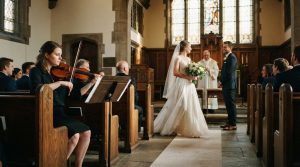
The traditional bridal march isn’t the only fitting choice for the aisle. Wedding ceremony violin music can bring classical pieces and familiar pop songs into the ceremony, with selections tailored to each moment.
Choosing the songs is only part of the decision. Consider when the music will play, whether a solo violin or string ensemble suits the ceremony, and how the performance will fit the setting. A personal favorite can work beautifully even if it isn’t traditionally considered wedding music.
This guide shares classical and modern pop song ideas for the entrance, signing break, and exit. It also explains how to match a piece’s mood and pace to each ceremony moment, and what to consider when hiring a violinist or ensemble. The aim is a personal, cohesive musical plan that flows smoothly from guest arrival to the final notes.
Key Takeaways
- Choose between classical favorites and pop songs arranged for violin based on the mood you want, not just tradition.
- Plan distinct music for guest arrival, the processional, ceremony pauses, and the recessional.
- Match the tempo and feel of each selection to the moment, from a measured aisle entrance to an upbeat exit.
- When arranging live music, consider whether a solo violin or a string ensemble better suits the ceremony and its setting.
1. Classical violin wedding songs
Classical wedding ceremony violin music can feel formal without making every choice predictable. Pachelbel’s “Canon in D” offers a familiar alternative to the Wedding March or Bridal March. It was originally written for three violins and basso continuo, and began gaining popularity as a wedding song in the 1900s. Historians estimate it was composed between the late 1600s and early 1700s. A violinist can shape its flowing phrases with expressive phrasing, articulation, and vibrato.
For a processional, consider Bach’s “Jesu, Joy of Man’s Desiring.” Bach composed it between 1716 and 1723. Its violin part is in 6/8 time, with steady eighth notes and mostly stepwise motion. That measured movement gives the entrance a graceful, continuous feel. For a more intimate classical choice, Edward Elgar’s “Salut d’Amour” brings a personal story: he wrote it in 1888 as a love note for his future wife. It can also suit pre-processional or recessional music.
Other solo violin repertoire offers distinct textures. The movement known informally as “Air on the G string” was transposed in 1871 to be played entirely on the G string. Its sustained melodic line creates a different character from the flowing pattern of “Canon in D.” Contemporary songs can sit alongside these works. For example, an instrumental violin arrangement of Elvis Presley’s “Can’t Help Falling in Love” can connect a familiar melody with a classical program. A song can belong in the ceremony because it matters to the couple, not only because tradition labels it wedding music.
Copyright and venue rules depend on how the music is used and on the venue’s policies. Ask the venue who handles permissions for live performance, and clarify whether separate rules apply to recording or sharing the music.
2. Modern pop songs arranged for violin
A pop melody can sound polished on violin when the arrangement preserves its recognizable hook. Meghan Trainor’s “Made You Look” brings a playful mood to a ceremony pause or exit. Lana Del Rey’s “Young & Beautiful” suits a more emotionally charged atmosphere. “Nothing Else Matters” offers a distinctive alternative for several ceremony moments, depending on its tempo and arrangement.
Consider how the original song’s mood translates without vocals. “Can You Feel the Love Tonight,” recorded by Elton John for the 1994 film The Lion King, has a clear melody that can carry an instrumental version. Ellie Goulding released “Love Me Like You Do” for the Fifty Shades of Grey movie in 2015; its broad, expressive lines can create an elegant feel on violin. “You Raise Me Up” can be played softly as ceremony background music. Give the melody space, especially during spoken readings or other quiet moments.
A violin-and-cello arrangement adds contrast while preserving the song’s identity. The violin can carry the melody as the cello supports it with lower harmonies or a steady bass line. This pairing gives a familiar pop song a fuller sound than solo violin. For a restrained passage, keep the cello soft beneath a sustained violin phrase. For a clearer pulse, use a measured cello pattern and let the violin emphasize the hook. Leave room in the arrangement for voices and ceremony cues.
Choose the song by matching its emotional character to the moment, then decide whether solo violin or violin and cello best serve that mood. A quieter arrangement of “You Raise Me Up” can sit behind the ceremony, while “Made You Look” can bring more energy to the exit. For couples considering live wedding music, the key is a coherent performance that suits the event’s mood and musical direction.
3. Pre-processional and recessional music
Plan music for the moments before the entrance and after the ceremony, not just the aisle walk. Pre-processional selections welcome arriving guests and set the atmosphere as they take their seats. Choose a calm piece that can be repeated or followed naturally by another selection. A solo violin keeps the sound intimate, while the song sets the tone before the processional begins.
For the aisle entrance, match the music’s pace to the walk. Ludovico Einaudi’s “I Giorni” is a slow, elegant option with a measured feel. “Salut d’Amour” can also work before the processional. Listen to the chosen arrangement in full, then identify where the entrance should begin. This connects the music to the moment without starting halfway through a phrase.
Give the recessional a different energy. Kodaline’s “The One” is suggested as wedding exit music, while Foo Fighters’ “Learn To Fly” can bring an upbeat feel to the couple’s departure. An instrumental version of “Mr Brightside” offers another lively option, emphasizing the recognizable melody without vocals. Choose a tempo that makes the exit feel celebratory rather than carrying the entrance’s slower mood into the final moment.
Plan a simple sequence: guest arrival, processional, ceremony music, then recessional. Mark each transition with a clear cue, such as the officiant’s introduction or the couple’s first steps down the aisle. A playlist chosen by the couple can provide music before and after the ceremony, keeping personal choices present beyond the entrance. Keep the selections cohesive by choosing songs with compatible moods, even when their styles differ. For example, pair Einaudi’s “I Giorni” with the brighter “Learn To Fly” to create a deliberate shift from reflective entrance to joyful exit.

4. Hiring a wedding violinist or string ensemble
Start by matching the performers to the ceremony’s sound and scale. A solo violin keeps the arrangement focused on one melodic line. A string ensemble can layer melody and harmony for a fuller texture in a larger space or a more arranged sound. The choice also affects repertoire: a soloist may suit a delicate entrance, while multiple strings can add depth to a familiar pop melody.
Share the ceremony sequence and selected songs before the performance. Identify the processional, any music during signing or photos, and the recessional. Provide the entrance order and clear musical cues, such as when the first guest or wedding party begins walking. These details help the performer shape transitions rather than treating each selection as a separate piece.
Indoor and outdoor settings call for different sound planning. In a small indoor room, the violin may carry naturally; in a large hall or open-air ceremony, its sound can disperse. A solo violinist brought a sound system to a wedding ceremony at Yampa Botanic Garden in Steamboat Springs, Colorado. Plan the setup around the ceremony layout, audience position, and whether amplification is needed. For an outdoor performance, position the musician where guests can see and hear the playing, while protecting the instrument and equipment from direct exposure.
Before the event, align the music plan with the venue’s layout and schedule. Share the ceremony start point, transitions, and any announcements that could affect timing. Keep a final song list in performance order, with titles written clearly. That simple document gives the musician a reliable reference and helps prevent confusion between similarly titled arrangements. For a live performance that fits your ceremony plan, explore wedding entertainment options and choose an approach that supports the music you want played.
The R Factor: Wedding Entertainment
The R Factor is a natural next step if you want live wedding music that connects ceremony selections with the wider event. Its 6 to 12 piece cover band includes a violin, combining that sound with vocalists, horns, and a rhythm section. Flexible group sizes let the performance suit the scale and requirements of the occasion.
Consider The R Factor when you want more than a solo instrumental performance and would like a live band as part of your wedding entertainment. Based in Minneapolis-St. Paul, the band also performs at corporate events, birthday parties, and private parties.
Contact The R Factor to discuss your wedding entertainment.
Shape the Music Around Your Celebration
Let the ceremony’s musical direction carry into the celebration that follows. A thoughtful plan for wedding ceremony violin music can make the event feel personal and give each transition a clear purpose. Decide which moments should feel reflective, which should invite energy, and how live music can support the whole occasion.
The R Factor provides wedding entertainment, corporate event music, and birthday party performances. If you’re planning a wedding and want live music to shape the event, share your ideas and the atmosphere you have in mind. A clear sense of the celebration helps shape a performance that fits its character.
Contact The R Factor to discuss Wedding Entertainment for your celebration. Your musical choices can help make the day unmistakably yours.
Frequently Asked Questions
What violin music is traditionally played during a wedding ceremony?
Traditional ceremony choices include the Bridal March and Pachelbel’s “Canon in D.” The Bridal March signals the entrance, while “Canon in D” offers a classical alternative with a gradual, flowing feel. Couples can also choose a meaningful pop song arranged for violin. For a personal touch, select a melody connected to your relationship, then consider whether its mood suits the ceremony moment.
What are popular violin songs for wedding processional and recessional?
For a processional, slow, graceful pieces such as Ludovico Einaudi’s “I Giorni” create a measured pace. “Salut d’Amour” can also suit an entrance or exit. For a more upbeat recessional, consider an instrumental arrangement of “Mr Brightside,” Kodaline’s “The One,” or Foo Fighters’ “Learn To Fly.” Choose according to the energy you want guests to feel as you leave.
What violin music works best for the bride’s entrance?
A piece with a steady, unhurried melody works well for the bride’s entrance, supporting a composed walk. “Canon in D” and “I Giorni” are classical choices with a graceful character. A meaningful pop song can work just as well in an instrumental arrangement. Listen to the full arrangement and choose a clear starting point that fits the entrance cue.
How much does it cost to hire a violinist for a wedding ceremony in the U.S.?
The cost depends on factors such as performance length, location, travel, ensemble size, repertoire, and setup needs. A solo violinist and a larger group require different arrangements, while an outdoor venue can affect sound planning. For The R Factor’s wedding entertainment, pricing depends on the event details and is provided after a quote request. No single average applies to every wedding.
How far in advance should you book a wedding ceremony violinist?
Book once your ceremony date and venue are set, especially if you have a specific musician or ensemble in mind. This gives you time to coordinate song choices, processional cues, ceremony pauses, and the recessional. Popular dates may have fewer performers available, so early planning leaves more room to shape the music without rushed decisions.
How do you choose between a solo violinist, violin and piano, or a string quartet?
Choose a solo violinist for a focused melody and a compact musical presence. Violin and piano add harmonic support and can give a familiar song more fullness. A string quartet offers layered parts and a richer ensemble sound. Let the ceremony’s atmosphere, venue, and preferred repertoire guide your choice. For instance, a quiet chapel may suit a solo arrangement, while a larger ceremony can benefit from fuller textures.
Recent Comments