

Last Updated: November 12, 2026
Quick Summary
Book a live band anniversary performance for a small party by first defining your guest count, venue, timeline, and must-play songs, then comparing quotes that list lineup, set length, overtime rate, and equipment. A small acoustic group suits dinner-focused evenings, while a full band fits dance-focused celebrations. Confirm all terms in writing before paying the deposit.
- Define guest count, venue, date, timeline, and must-play songs before requesting quotes.
- An acoustic lineup suits dinner-focused parties, while a full band suits dancing.
- Confirm the overtime rate and who supplies sound and lighting before signing.
- Most anniversary parties book about three to four hours, split into dinner and dance sets.
- Put the fee, deposit, cancellation terms, and special songs in the contract.
Table of Contents
- Why a Live Band Works at a Small Anniversary Party
- Choosing the Right Band Size and Lineup for 40 to 100 Guests
- Acoustic Band for Dinner Party Settings
- Anniversary Party Band Cost: What Shapes the Price
- Questions to Ask a Party Band Before You Book
- How Long a Live Band Should Play at Your Party
- Booking Your Anniversary Band: Your Next Step
- Frequently Asked Questions
Why a Live Band Works at a Small Anniversary Party
A live band for a small anniversary party gives guests something a playlist cannot: music that responds to the room, and a live band anniversary celebration that feels alive. Musicians can read the crowd, stretch a song that is landing well, and shift the mood when the dinner conversation slows down. For couples hosting 40 to 100 guests, that responsiveness turns a pleasant evening into a memorable one.
The format also fits the milestone itself. An anniversary is personal, and a band can build the set around the couple’s favorite songs from the years they have spent together. A band that takes specific requests can build the set around the couple’s favorite songs, and that is the heart of a live band anniversary night.
Small events have a few advantages over large ones. The sound can be tuned to a more intimate room, and the band can play at a conversational volume during dinner and build energy after the toasts. A clear plan for the evening keeps the transitions smooth, so the music supports the celebration instead of competing with it.
Watch out: booking a band that is too loud for the room is the most common way to spoil a dinner. Ask early about volume levels and how the set will shift between dinner and dancing.
Choosing the Right Band Size and Lineup for 40 to 100 Guests
Band size shapes both the sound and the cost. A larger ensemble fills a big room with horns, layered vocals, and a full rhythm section. A smaller group can suit a room of 40 to 100 guests.
Most couples at this guest count choose between a full band and a smaller lineup. The right answer depends on whether the party is built around dinner, dancing, or both. A full band suits a celebration where dancing is the main event. A smaller group is usually the better fit when the evening centers on conversation and a long dinner.
Full band vs. small acoustic lineup
A full band brings the most energy and the widest song catalog. It can cover many decades and styles, which helps when guests span several generations. The trade-off is volume, setup space, and budget.
A small acoustic lineup works well for an intimate dinner. It plays at a comfortable level, needs less space, and can shift easily from background music to a dance set. Choose the option that matches your guest count, your venue, and how much of the night you want the music to lead.
Acoustic Band for Dinner Party Settings
An acoustic band is often the right choice when the anniversary dinner comes first. The music sits underneath the conversation, so guests can talk without raising their voices. Many couples book a small acoustic group for the meal, then bring in the full band or a larger set for the dance portion.
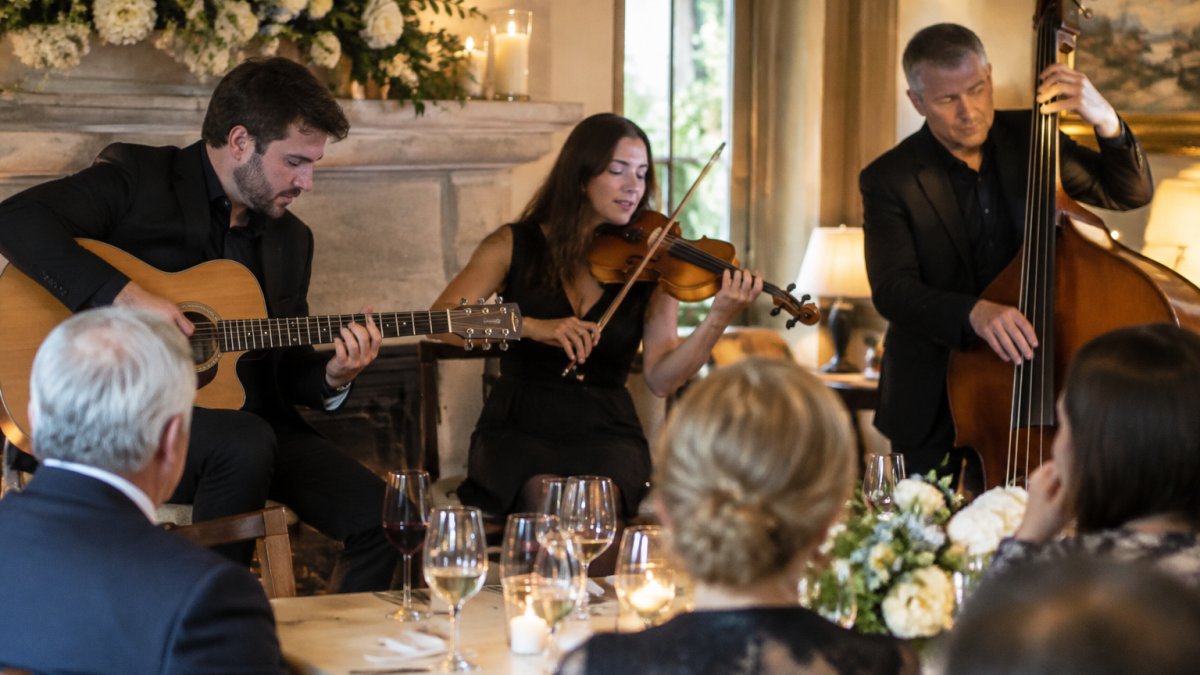
Acoustic players also handle requests well. A two- or three-piece group can switch songs quickly and adapt to the mood of the room. Ask whether the lineup can play both background sets and a louder dance set, and confirm the transition time between them.
Anniversary Party Band Cost: What Shapes the Price
Most directory listings stop at a starting price. The number that actually lands on your contract is built from several line items, and understanding them is how you compare two bids that look different but may not be.
Lineup size is the biggest lever. A solo acoustic performer or duo carries one or two performance fees. A four- to six-piece band multiplies that across every musician, and each added horn or vocalist adds both a fee and a monitor mix. For a 40-to-100-guest anniversary, the jump from a trio to a five-piece is usually the single largest change in the quote.
Performance length and sets. Bands typically quote a package of continuous hours, often three to four, split into sets with breaks. Overtime is commonly billed per hour or per half hour at a higher rate than the base package, so confirm the overtime rate before you sign rather than after the last dance is requested.
Date and season. Saturday evenings in peak wedding and anniversary season command the highest rates. Off-peak dates, Fridays, Sundays, and colder months, are where negotiating room usually exists. Holiday weekends sit at the top of the range.
Travel and service area. Local bookings inside a band’s home service area usually carry no travel charge. Beyond that radius, expect mileage, drive time, and sometimes a hotel night for out-of-town dates. Ask each band to state its service area and travel policy in writing.
Equipment and production. A quote may or may not include the PA system, microphones, stage lighting, and an on-site engineer. Full-service production can reduce the need to rent gear separately or to check whether a venue’s system can handle a larger band.
Deposits and payment terms. A deposit, commonly a percentage of the total, holds the date, with the balance due before the event. Payment schedule, accepted methods, and whether the deposit is refundable are all part of the real cost of booking.
How to compare quotes fairly. Ask every band for the same breakdown: base package hours, overtime rate, lineup included, production included, travel, deposit amount, and cancellation terms. A lower headline number with no sound system and no crew is often more expensive once you add rentals and coordination. Request itemized quotes for your date, guest count, and venue so the comparison is apples to apples.
The price on a band’s quote depends on several line items, and comparing them side by side shows where the real differences lie.
| Cost factor | What drives it | What to check |
|---|---|---|
| Lineup size | Each added musician adds a fee and monitor mix | Ask for the exact number of players |
| Performance length | Base package covers continuous hours | Confirm sets and breaks |
| Overtime | Billed per hour or half hour, often at a higher rate | Confirm rate before signing |
| Date and season | Peak Saturdays and holidays cost the most | Off-peak dates can offer room to negotiate |
| Travel | Mileage, drive time, sometimes a hotel night | Ask for the service area in writing |
| Equipment | PA, microphones and lighting may or may not be included | Confirm who supplies the gear |
| Deposit | Commonly a percentage that holds the date | Check whether it is refundable |
Questions to Ask a Party Band Before You Book
A question list is only useful if it follows a sequence. Work through these in order, because each answer shapes the next decision, and the answers belong in the contract, not just in an email.
1. Define the event before you call anyone. Write down guest count, venue, date, start and end times, whether the evening is dinner-first or dance-first, and two or three must-play songs for the couple. This one-page brief is what every band will quote against, and it keeps bids comparable.
2. Confirm lineup and instrumentation. Ask exactly who plays, how many musicians, which instruments, how many vocalists, and whether substitutions are allowed. A band that markets a five-piece but arrives as a four-piece changes the sound you paid for.
3. Nail down performance length and structure. Ask how many sets, how long each runs, how long the breaks are, and whether recorded music plays during breaks. Confirm the overtime rate and how it is triggered.
4. Ask about sound, lighting, and power. Does the band supply its own PA, microphones, and lighting, or does the venue? What power does the setup need, and who runs the sound check? For a home or small venue, ask how the band keeps volume conversational during dinner and whether it can adjust to local noise limits.
5. Confirm requests and special songs. Ask how far in advance the couple’s must-play songs are needed, whether the band will learn a song not in its catalog, and whether there is a charge for learning it. First-dance and anniversary-song moments should be confirmed in writing.
6. Review the contract terms. The contract should state the total fee, deposit amount and due date, balance due date, cancellation and postponement policy, overtime rate, force-majeure language, and who provides equipment. Ask what happens if a musician is ill or equipment fails, a professional band carries a backup plan and, often, substitute players.
7. Check load-in, space, and timing. Ask for the band’s space and load-in requirements and share them with the venue. Confirm setup and breakdown times so the band is not setting up during dinner or breaking down during the last dance.
8. Verify insurance and reviews. Ask whether the band carries liability insurance, which venues often require, and read recent reviews for events similar in size to yours rather than only large weddings.
9. Get it in writing and pay the deposit. Once the terms match the brief, sign the contract and pay the deposit to hold the date. Keep a single point of contact for the day of the event.
Watch out: a verbal promise about a special song or an overtime rate is not a booking term, if it is not in the contract, assume it will not happen.
How Long a Live Band Should Play at Your Party
For most anniversary parties, a live band plays for about three to four hours, usually split into a dinner set and a dance set. The dinner portion typically runs at a softer volume, while the dance portion picks up energy after toasts or cake. Some couples prefer a shorter performance with a focused dance set, while others book a longer evening to cover cocktails, dinner, and dancing.
Set length should match the timeline of your event. Confirm when the band starts, when breaks occur, and when the final song is scheduled. Build in time for any ceremony, toasts, or special performances so the band knows where it fits.
Booking Your Anniversary Band: Your Next Step
Once you have answered the seven questions above, you have a clear picture of what to ask for. The next step is to request quotes from bands that match your guest count, venue, and music style. Share your date, timeline, and any special songs, and ask each band to confirm what is included.
The R Factor brings 30 years of experience, a catalog of 750 songs, and full-service production with sound, lights, and a road crew. Get started by reaching out to The R Factor for a quote for your anniversary date and guest count.
Frequently Asked Questions
How much does a live band cost for a small anniversary party?
Pricing depends on band size, the number of hours booked, travel distance, and the date of your event. Small acoustic lineups generally cost less than full bands because they require fewer musicians and less equipment. Pricing depends on quantity, dates, and delivery, so the most accurate figure comes from a quote tailored to your guest count, venue, and performance length. Check The R Factor’s website for current prices or to request a quote.
What size band is best for a small anniversary party?
For gatherings of roughly 40 to 100 guests, a small acoustic lineup or a scaled-down group often suits the room better than a full ensemble. A full band fits well when you want dancing and a high-energy atmosphere. The R Factor can scale its lineup from 6 to 12 pieces, so you can match the configuration to your guest count, space, and the style of celebration you have in mind.
How long should a live band play at an anniversary party?
Most anniversary parties benefit from a performance that runs in sets with breaks between them, so guests can talk and eat. Ask the band how it structures its sets and how many breaks it recommends for your event length. Discuss whether you want background music during dinner, a featured performance, or a dance set later in the evening, and confirm the total performance window when you book.
What should you ask a band before booking them for an anniversary party?
Ask about availability on your date, the lineup you will receive, whether the band takes song requests, and how far in advance you should finalize your set list. Confirm what equipment and production support are included, who is responsible if a technical issue arises, and what backup plan exists. Ask any band you consider for references from recent events of a similar size so you can judge performance quality before you commit.

Recent Comments