
Last Updated: November 7, 2026
Quick Summary
To book professional band talent for a fundraiser, define your date, venue, times, guest count and budget first, then request itemized quotes from at least three bands. Compare what each price includes, confirm availability in a signed agreement, and map the music to your run-of-show.
- Pricing depends on band size, performance length, date, travel distance, and production needs.
- Ask every band for an itemized quote covering fees, travel, sound, breaks, and overtime.
- Match band size to your room and guest count before matching it to your budget.
- Share your run-of-show early so the band can time transitions around speeches and the appeal.
- Confirm availability in a signed agreement, not a verbal hold, and review cancellation terms.
Table of Contents
- Why Fundraisers Benefit From a Professional Band
- How Much to Book a Professional Band for a Fundraiser
- Choosing the Right Band Size and Music Style for Your Crowd
- Setting Performance Length and Set Structure
- How to Book a Music Artist for an Event: Step by Step
- Your Fundraiser Band Booking Checklist and Next Step
- Frequently Asked Questions
Why Fundraisers Benefit From a Professional Band
A live band changes how guests behave at a fundraiser. When you decide to book professional band talent, you get a reliability that a playlist or a volunteer DJ often cannot match.
Music also gives the event a clear identity. Guests remember a fundraiser for its atmosphere, and a well-chosen band becomes part of that memory.
The benefits tend to cluster in a few areas:
- Guest engagement: Dance floors fill, and guests circulate instead of sitting through long program blocks.
- Timing control: Experienced bandleaders can stretch or shorten a set to cover a delayed speech or a longer auction.
- Reduced planning load: A band that handles sound and production removes a layer of work from your volunteer committee.
The trade-off is cost, and that is the part most organizers need to plan carefully. The next section breaks down what a professional booking typically involves.
How Much to Book a Professional Band for a Fundraiser
Pricing for live music varies widely, so before you book professional band services, know that no single number applies to every event.
Published estimates give a rough sense of the range. Pricing for live music varies widely, and any published estimate should be treated as a rough reference rather than a quote.
For current pricing that reflects your date, guest count, and setup, contact The R Factor directly through our website for a quote.
What Drives the Price Up or Down
Several factors move the price more than any others:
- Band size: A larger ensemble with horns, strings, or multiple vocalists costs more than a smaller group. Each additional player adds a per-musician fee and often a separate travel and lodging line.
- Performance length: A two-hour set costs less than a full evening of music. Bands commonly quote a base package and charge overtime by the hour or half-hour, so confirm the terms in writing.
- Date and time: Weekend evenings and peak seasons typically carry higher rates. A Saturday in the spring gala season may cost more than a Thursday in late summer.
Building an Itemized Budget
A transparent quote separates fixed costs from variables. Ask each band to break the fee into these lines so you can see what you are actually buying:
- Performance fee, the base rate for the agreed number of sets and total stage time.
- Travel and lodging, mileage, tolls, parking, and hotel nights if the call time is early.
- Sound and production, PA, monitors, microphones, lighting, and any backline the band supplies.
- Overtime, the hourly rate if the program runs long or you add an encore set.
- Deposit and payment schedule, typically a deposit to hold the date, with the balance due before or on the event day.
- Cancellation and rescheduling terms, what portion of the fee is refundable and under what timeline.
Deposit and payment schedules vary, so confirm the exact schedule in the contract rather than assuming.
Watch out: a quote that bundles everything into one number makes it hard to tell whether you are paying for production, travel, or extra time. If a band will not itemize, ask for a written scope that lists what is and is not included.
Comparing Quotes Fairly
When you have three quotes, normalize them before deciding. Check whether each includes sound and lighting, how many total hours are on stage, whether breaks are paid time, and what the overtime rate is. A higher headline fee that includes production and a full evening of music can cost less than a lower fee plus separate AV rental and overtime charges. Put the numbers side by side in a simple spreadsheet with the same line items for every band, and note any assumptions each band made about load-in, stage size, or power access.
The article breaks the cost down by the main factors that move the price, which a reader can scan quickly.
| Factor | Effect on price | Note |
|---|---|---|
| Band size | Higher | Each extra player adds a per-musician fee |
| Performance length | Higher | Overtime is often billed by the hour or half-hour |
| Date and time | Higher on peak dates | Weekend evenings and spring gala season cost more |
| Travel distance | Higher | May add travel and lodging costs |
| Production needs | Higher unless provided | Bands with their own PA can be cheaper overall |
| Load-in and setup time | Higher | Complex stages need more time on site |
Choosing the Right Band Size and Music Style for Your Crowd
Match the band to the room before you match it to a budget. A nine-piece group fills a large ballroom with energy, but it may overwhelm a small reception where guests want to talk.
Music style matters just as much. A repertoire built around familiar songs can also make room for a focused tribute set, with Theatre of the Rockies offering a useful point of comparison when weighing how closely a performance should evoke a particular artist.
Ask the band to share a sample setlist or a list of song categories before you commit. This shows whether the music fits your event and whether the band can take requests that suit your guests.
Setting Performance Length and Set Structure
Performance length determines both cost and guest experience, but at a fundraiser it also determines how much attention the room gives to the ask. Most fundraisers need music at several points: background music during dinner, a featured set during the party, and a closing set to end the night. Planning these blocks in advance keeps the band from playing through speeches or the auction, and keeps guests from drifting out before the appeal.
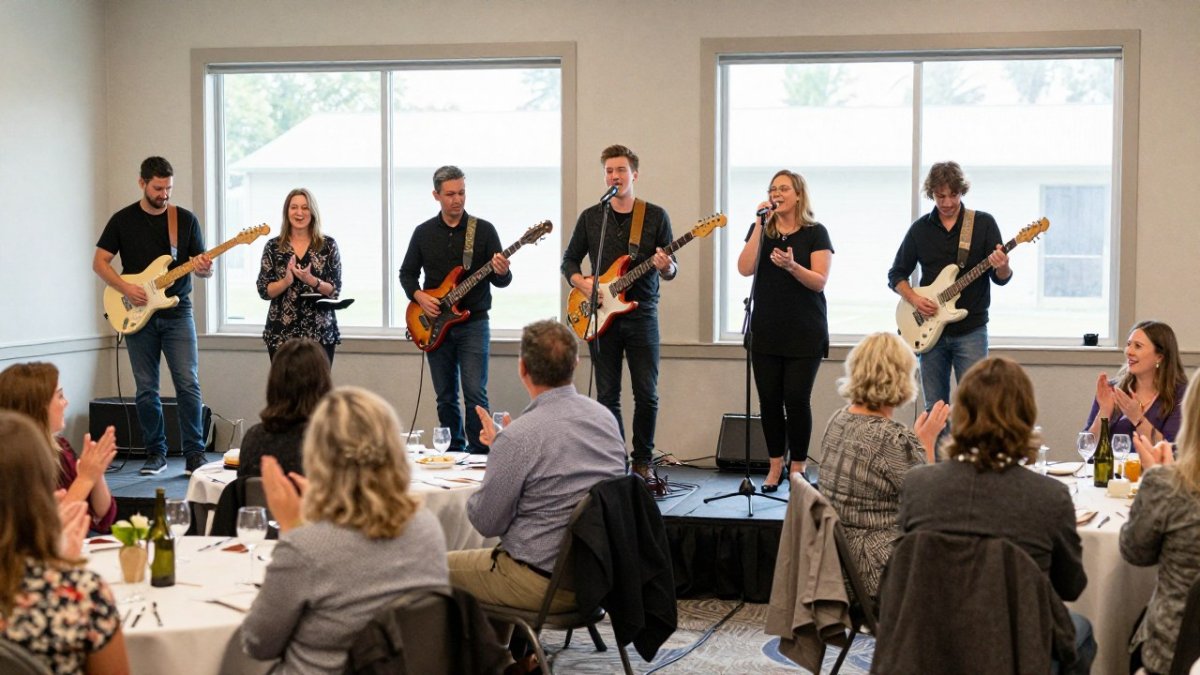
A common structure looks like this:
- Arrival and cocktail hour: Lighter, background-friendly songs at a moderate volume so guests can talk and visit auction tables.
- Dinner and program: Low-key music that does not compete with speakers. The band should be able to fade out quickly when the program begins.
- Main set: The highest-energy block, often after the program ends, timed to bring guests back to the dance floor and keep them in the room.
- Closing set: A shorter finale to wrap up the evening, ideally ending before the venue’s hard stop.
Connecting the Set List to Fundraising Moments
The strongest fundraiser bands treat the performance as part of the program, not a separate concert.
A practical pattern is to use the band to signal transitions.
Also confirm whether breaks are built into the booking and how long each break lasts. A 20-minute break during the auction can work in your favor; the same break during the appeal can empty the room.
Watch out: a set that runs too long can cut into your auction or closing remarks.
How to Book a Music Artist for an Event: Step by Step
Booking a band works best as a sequence. Following the same steps for every inquiry makes it easier to compare options fairly.
- Define your event details. Write down the date, venue, start and end times, guest count, and budget range.
- Set your music priorities. List the moments that need music and the mood you want at each.
- Shortlist candidates. Compare bands by repertoire, size, reviews, and fit with your event.
- Send a complete inquiry. Include all your event details so each band can quote accurately. Incomplete requests lead to vague estimates.
- Compare itemized quotes. Look at what each price includes: setup, sound, travel, breaks, and overtime.
- Confirm availability in writing. A verbal hold is not enough. Ask for a signed agreement that lists the date, times, fee, and cancellation terms.
- Review the contract before signing. Check the payment schedule, deposit terms, and what happens if the event is rescheduled.
Plan for lead time. Popular dates book quickly, so start your search several months ahead when you can.
Your Fundraiser Band Booking Checklist and Next Step
Use this checklist to keep your booking on track:
- Event date, venue, and start and end times confirmed
- Guest count and audience profile written down
- Budget range set, with a cushion for travel and production
- Band size and music style matched to the room
Booking a professional band for your fundraiser is a planning task that pays off on the night. Start with a clear event brief, compare itemized quotes, and confirm every detail in writing.
If you are ready to talk through your event, contact The R Factor for a quote tailored to your date, guest count, and program. The R Factor’s 8-piece ensemble, with four singers, a horn section, a rhythm section, and a violinist, provides sound, lighting, and production support so your team can focus on your guests and your cause.
Frequently Asked Questions
How much does booking a band cost?
Pricing for a band depends on lineup size, event date, event length, travel distance, and production needs such as sound and lighting. Published estimates for live-band costs vary widely and should be treated as reference points, not quotes. For current pricing for The R Factor, contact the band directly through its website for a quote tailored to your guest count and date.
How far in advance should I book a band for a fundraiser?
Book as early as you can, since popular bands fill their calendars for weekends and peak seasons. Reaching out several months ahead gives you the best chance of securing your preferred date and lineup. Provide your event date, venue, expected guest count, start and end times, and performance length when you inquire so the band can confirm availability quickly. Last-minute requests may still work for smaller lineups, but availability is not guaranteed.
How long should a band play at a fundraiser?
Most fundraisers schedule live music in blocks that match the program, such as a dinner set followed by a longer dance set. Ask the band how its sets are structured and how much material it can cover in your time window. Confirm breaks, the total number of playing hours, and whether the band will adjust its volume during speeches or auctions. Clarifying this before you sign prevents overbooking or gaps in the evening.
What should I ask a band before booking them for a fundraiser?
Ask about availability on your date, lineup size, sound and production requirements, setup time, and what is included in the quoted price. Request song-selection flexibility, the number of playing hours, and the cancellation and backup policy. Verify experience with similar events and whether they can learn specific requests. Review the contract for deposit terms, payment schedule, and what happens if equipment fails on the night of the event.

Recent Comments