

What if the songs that make a 50th birthday feel personal aren’t always the ones that get every guest onto the dance floor? The best live music for 50th birthday party celebrations reflects the guest of honour while giving the whole room a reason to join in. Balance familiar favourites with different tempos, and let the music build from relaxed conversation to dancing when the timing feels right.
It’s natural to want music that celebrates one person without leaving friends and family out. A little planning makes that balance easier. Start with the honouree’s tastes, consider the guest list, and plan how the music will fit around arrivals, dinner, speeches, and dancing. Before booking, confirm the band’s repertoire, lineup, and event logistics. A clear brief helps the performers understand what matters most and gives you a practical plan for the celebration.
Key Takeaways
- Start with the guest of honour’s musical preferences, then choose directions that give guests of different ages a shared point of connection.
- Use Motown, disco, classic rock, pop, or R&B as planning ideas, and confirm a band’s actual repertoire before booking.
- For live music for 50th birthday party celebrations, match the ensemble’s size and sound to the venue and the atmosphere you want.
- Compare performers by confirmed lineup and fit for your event, not musician count alone.
- Before the event, confirm venue requirements, schedule details, and performance logistics directly with the venue and performers.
Why live music can make a 50th birthday party feel personal
A 50th birthday can bring together friends, relatives, and colleagues with different musical tastes. They may not share the same favourite artists, but familiar songs, a live performance, and moments centred on the guest of honour can give everyone a way to connect. The band’s role can shift as the evening unfolds: music can sit behind conversation during arrivals, then take a more prominent place when it’s time to dance.
Background music may be right for some parts of the event. A live band adds a visible performance and gives you the option to plan different musical energy for different moments. It can’t guarantee a full dance floor or a particular reaction, but it can help connect the music to the occasion. Research into the psychological effects of music explores how music relates to emotion and social bonding.
Milestone-party entertainment works best when it reflects both the honouree and the event’s flow. For live music for 50th birthday party planning, that’s a more useful starting point than choosing songs based on age alone.
What makes live music a good fit for a milestone birthday?
Familiar songs can bring back personal memories and give guests an easy point of connection. A band can also help mark a change in pace: a lower-energy set may support mingling, while livelier selections can invite guests toward the dance floor. Discuss those transitions before the event. The aim is to create options for different moments, not to assume every guest will respond in the same way.
How to make the celebration feel like the guest of honour
Ask the guest of honour about meaningful musical eras, favourite artists, and songs connected to important memories. Then invite a small number of requests from guests to add variety without losing the honouree’s preferences as the focus. A song tied to a family tradition or shared trip may feel more personal than a hit chosen only because it was popular in a particular decade.
Let the honouree’s actual tastes guide the choices. They may love music from their teenage years, prefer recent releases, or enjoy a mix of genres and generations. Share possible songs and styles with the band, and confirm what it can perform before making those requests part of the plan. That keeps the music personal while setting realistic expectations.
Choose birthday-party music around the honouree and the guest list
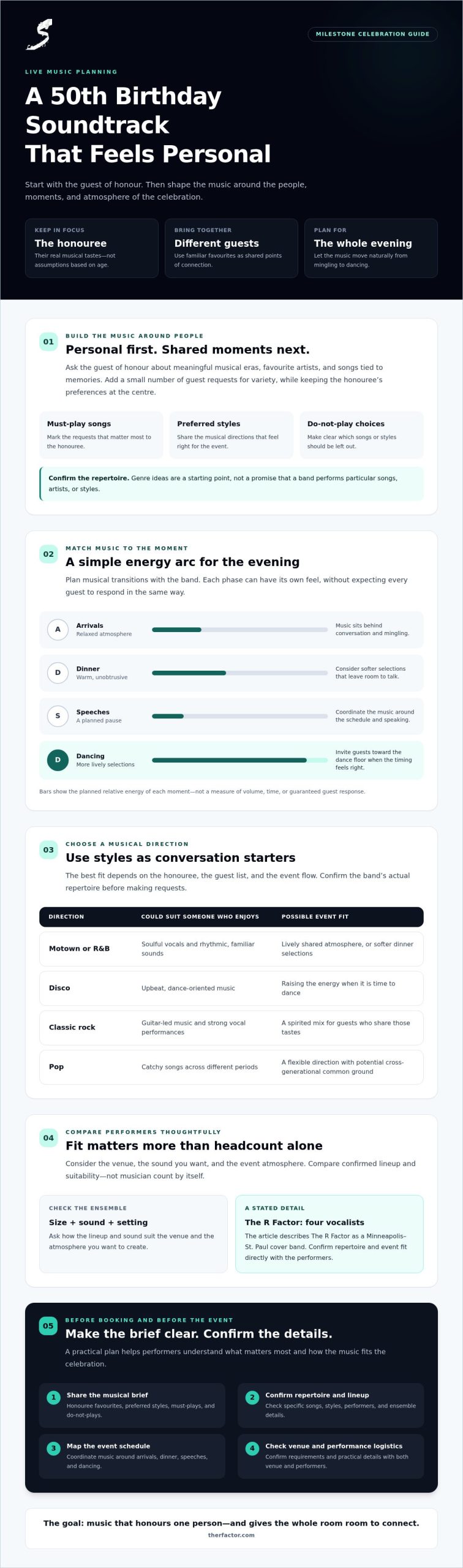
Build the musical direction around the guest of honour’s listening history, not assumptions about what someone of a particular age should enjoy. Then consider who’s attending and how you want the room to feel. Motown, disco, classic rock, pop, and R&B are useful starting points for a conversation, but they don’t guarantee that a band performs those styles. Confirm specific songs, artists, and genres with the performers before relying on them.
Which music styles suit a 50th birthday celebration?
Use this comparison to start a conversation with the honouree and a prospective band. These are possible musical directions, not a confirmed setlist.
| Musical direction | Consider it if the honouree enjoys | Potential fit for the event |
|---|---|---|
| Motown or R&B | Soulful vocals and rhythmic, familiar sounds | A lively shared atmosphere, or softer selections during dinner |
| Disco | Upbeat, dance-oriented music | Raising the energy when it’s time to invite guests toward the dance floor |
| Classic rock | Guitar-led music and strong vocal performances | A spirited mix for guests who share those tastes |
| Pop | Catchy songs across different periods | A flexible direction that may offer cross-generational common ground |
Each category can include energetic dance favourites as well as gentler choices for conversation. The right mix depends on the honouree, the guests, and the event schedule. Ask the band which specific songs and styles it can perform, rather than assuming a genre label covers every request. The Knot’s guide to hiring a band also offers practical questions to consider when discussing music and event needs with performers.
How do you balance different generations and music tastes?
Give the band three concise lists: must-play songs, preferred styles, and do-not-play choices. Keep the requests manageable and identify which songs matter most to the honouree. A set can move between styles and energy levels, instead of trying to satisfy every guest with every song. This keeps the celebration personal while leaving room for different guests to find familiar music.
Vocal variety may also be useful when guests have different tastes. The R Factor, a Minneapolis and St. Paul cover band for birthday celebrations and private parties, has four vocalists. Confirm its repertoire directly before requesting particular artists, songs, or genres. If you’re considering a local live band, explore The R Factor’s birthday party performances as one option to discuss for your event.
Plan the music across dinner, speeches, and the dance floor
Give live music a clear role at each stage of the evening, so it doesn’t compete with dinner, conversation, or announcements. For live music for 50th birthday party planning, share a draft schedule with the venue and performers early. Mark speeches, cake, dedications, and surprises, and agree on who will cue the band if the schedule changes.
What should the live-music timeline include?
Use this sample sequence as a starting point, then adjust it to your event’s schedule:
- 1. Guest arrival: Set a welcoming, lower-energy tone that leaves room for greetings and conversation.
- 2. Meal service: Keep the music supportive rather than competing with guests or staff communication.
- 3. Speeches and key moments: Schedule pauses or suitable transitions for toasts, cake, dedications, and surprises.
- 4. Dancing: Move into livelier material after formal moments, when the host is ready to shift the focus.
- 5. Planned finish: Agree on the performance end time and how the final musical moment fits the event’s close.
A clear timeline lets live music complement each moment instead of competing with it. Ask the venue about performer access, setup and sound-check timing, and any sound restrictions. Confirm who will cue the band, who will pass along schedule changes, and how the day-of contact can reach the performers.
How can music keep the party lively without overpowering guests?
Plan the volume and energy around what’s happening in the room. Lower-energy selections can support conversation during arrivals or dinner; livelier material can come later. These are planning directions, not promises about a particular band’s repertoire. Confirm the available songs and discuss how the performers can follow the agreed schedule.
Talk with the venue and band about room size, layout, and the space available for the performance. A setup that works in one room may feel crowded or sound different in another. Ask how the performers approach volume for conversation, announcements, and dancing, and check whether the venue has sound expectations. The band can adjust its performance, but it can’t control every guest’s participation or the room’s acoustics.
Put the schedule, key cues, and a day-of contact in one shared brief before the event. That gives the host, venue, and performers a common reference if the evening runs ahead or behind.
Compare live-band options and prepare a clear booking brief
Choose a band that suits the room, the guest experience, and the music you want to hear. A smaller ensemble may fit a compact performance area or a more intimate atmosphere. A fuller band can create a broader onstage sound, but it needs suitable space and should match the event’s priorities. Musician count alone doesn’t tell you whether a band is right for the celebration. Compare the confirmed lineup, relevant private-event experience, repertoire fit, and how clearly the performers discuss your plans.
The R Factor offers ensemble options ranging from 6 to 12 musicians, with four vocalists, a horn section, a rhythm section, and violin. Those options can be discussed in relation to the room and event, but don’t assume every lineup is available for every date. Ask the band to confirm the proposed configuration and event details before deciding.
What should you ask a live band before booking?
Ask about availability for your date, lineup options, confirmed repertoire, performance schedule, and how the band handles song requests and do-not-play choices. Clarify venue access and setup needs, and agree on who is responsible for coordinating each detail. If available, ask for examples of birthday or private-event performances that are relevant to your plans. These questions help you compare performers on the details that matter to your event.
How should you choose the right ensemble size?
Start with the room and the atmosphere you want. Consider where performers will set up, how much space guests need, and whether you prefer an intimate feel or a fuller live sound. Then compare the confirmed lineup with your musical brief. For more practical preparation, review this private party band booking guide.
Before contacting performers about live music for 50th birthday party plans, gather the essentials into a concise booking brief:
- Date and venue: Include the location, room details, and venue contact.
- Guest experience: Describe the atmosphere you want and the space available for music.
- Timing: Share arrival, meal, speeches, dancing, and planned finish times.
- Music preferences: Note meaningful artists or songs, preferred styles, and any exclusions. Ask the band to confirm repertoire.
A clear brief makes it easier to compare options using the same criteria. To discuss birthday and private-party performance options, contact The R Factor about your event.
Bring the 50th birthday music plan together in Minneapolis-St. Paul
A strong plan brings five decisions together: what the guest of honour enjoys, who’s coming, which musical direction suits the gathering, how the evening will unfold, and what the venue can accommodate. Keep those details in one event brief. It gives the venue and performers a shared reference and helps prevent important requests from getting lost in last-minute updates.
Venue procedures and event requirements can vary with the location and setup. Confirm access arrangements, sound expectations, and other logistics directly with the venue and performers. Clear coordination is especially helpful when the celebration includes speeches, a cake presentation, dedications, or schedule changes.
What should hosts confirm in the final planning conversation?
Before the event, review the agreed details with the band and venue. Make sure everyone has the same information about:
- Date and venue: Confirm the event location, access arrangements, and main contact for the day.
- Performance plan: Verify the schedule, proposed ensemble configuration, and any venue requirements for the performance area and sound.
- Music: Reconfirm which requested songs and styles are in the band’s repertoire, along with any do-not-play selections.
- Key moments: Share the timing for introductions, speeches, cake, dedications, and planned surprises, and identify who will communicate changes.
For live music for 50th birthday party plans, these final checks connect the honouree’s preferences with practical event details. Confirm each item directly instead of assuming that a request or arrangement has been understood.
How can a live band keep the celebration personal and flexible?
A confirmed ensemble can perform selected songs for the guests in the room while following the agreed schedule and musical direction. The R Factor performs at birthday celebrations and private parties in the Minneapolis and St. Paul area, with ensemble options ranging from 6 to 12 musicians. Its lineup includes four vocalists, a horn section, a rhythm section, and violin. Discuss the proposed configuration and repertoire directly with the band; don’t assume every lineup or requested song will suit every event.
Once you’ve gathered the honouree’s preferences, guest considerations, schedule, and venue details, Explore The R Factor’s live entertainment. Share your event’s musical priorities and discuss which confirmed performance option may fit the celebration.
Make the Music Plan Your Own
The strongest live music for 50th birthday party celebrations starts with the guest of honour’s real musical tastes, then makes room for the people sharing the occasion. Choose a direction that reflects their life, confirm requested songs with the performers, and map the music to the evening’s flow, from arrivals and dinner to speeches and dancing.
A clear brief keeps practical details in view. Share the schedule, venue requirements, preferred lineup, and special dedications with the band, then confirm who will handle event-day communication. That preparation helps the music complement the celebration without competing with its important moments.
For hosts planning in Minneapolis and St. Paul, The R Factor performs at birthday celebrations and private parties. Its flexible ensemble options range from 6 to 12 musicians and include four vocalists, a horn section, a rhythm section, and violin. Confirm the lineup and repertoire that fit your event, then explore The R Factor’s live entertainment.
With thoughtful choices and clear coordination, you can give the guest of honour a celebration that feels personal from the first song to the last.
Frequently Asked Questions
What kind of live music is best for a 50th birthday party?
The best choice reflects the guest of honour’s actual musical tastes and suits the atmosphere you want. Start with artists, eras, and styles they enjoy, then consider whether the event calls for relaxed music during dinner, upbeat selections for dancing, or a mix. Motown, disco, classic rock, pop, and R&B are possible directions, not guaranteed band repertoire. Confirm specific songs and styles with performers before booking.
Can a live band play songs from different decades at a 50th birthday?
Yes, if the band performs the requested songs and can shape a set around them. Share a shortlist spanning the decades and styles meaningful to the guest of honour, then ask the band to confirm each song is in its repertoire. You can also include familiar choices for guests with different tastes. Treat specific artist and song suggestions as requests until the performers confirm them.
How do I choose music that suits both the birthday guest and the guests?
Keep the honouree’s preferences at the centre, then use guest requests to add variety. Ask the guest of honour about must-play songs, favourite styles, and music they’d rather not hear. Invite guests to suggest a few favourites, too, but don’t try to satisfy everyone with every selection. A varied set can move between styles and energy levels, giving guests different ways to connect with the music.
What should I ask a band before booking it for a 50th birthday party?
Ask whether the band is available for your date and which lineup options it can confirm. Discuss repertoire, requested songs, do-not-play choices, performance timing, and how the music can fit around dinner or speeches. Ask about venue access, setup needs, sound expectations, and who will coordinate schedule changes. Request relevant birthday or private-event examples if available. Confirm the agreed details with the band and venue before the event.
How many musicians do you need for a 50th birthday party?
Choose a lineup based on the available performance space, the sound you want, and the overall guest experience, not musician count alone. A smaller ensemble may suit a compact room, while a fuller band may fit when the space and event priorities support it. The R Factor offers options ranging from 6 to 12 musicians in Minneapolis and St. Paul. Confirm the proposed lineup and its fit for your venue directly with the band.
When should live music start at a birthday party?
Set the start time according to the event schedule. Some hosts want live music as guests arrive; others prefer it to begin after dinner or formal remarks. Map out arrivals, meal service, speeches, cake, dancing, and the planned finish, then discuss the performance schedule with the band. Confirm access and sound-check timing with the venue, too. This gives everyone a shared plan and a way to communicate changes on the day.
Can a live band provide quieter music during dinner and livelier music for dancing?
Many bands can discuss changes in musical energy across an event, but confirm the options with your chosen performers. Explain when guests will be eating and talking, when speeches will take place, and when you’d like to shift toward dancing. Discuss appropriate volume for the venue, room layout, and performance area with both the band and venue. Acoustics vary, so agree on the plan rather than assuming how the room will sound.
Recent Comments