
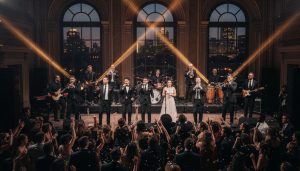
A standard wedding band provides music, but an 11-piece ensemble creates a definitive cultural event. If you are planning a celebration in a grand ballroom, you likely worry that a smaller group will sound thin or fail to fill the space with the energy your guests deserve. When selecting an 11-piece wedding band in Minneapolis, ensuring your chosen venue can actually accommodate it is about more than just sheer volume. It’s about the specialized musical layers and studio-quality depth that only a full horn section and multiple vocalists can provide.
You want your reception to feel like a high-energy concert where every genre sounds authentic, not like a compromise. At The R Factor, we understand the anxiety of managing complex logistics in historic local spaces. This guide explores how a large-scale ensemble delivers a seamless wall of sound while an experienced management team handles every technical detail behind the scenes. You’ll discover how to transition between musical styles effortlessly and ensure your investment results in a packed dance floor from the first note to the final encore.
Key Takeaways
- Large-scale Twin Cities venues require sound density to fill grand ballrooms effectively without relying on excessive volume.
- A four-vocalist frontline and dedicated horn section allow for authentic transitions between musical genres and complex, studio-quality harmonies.
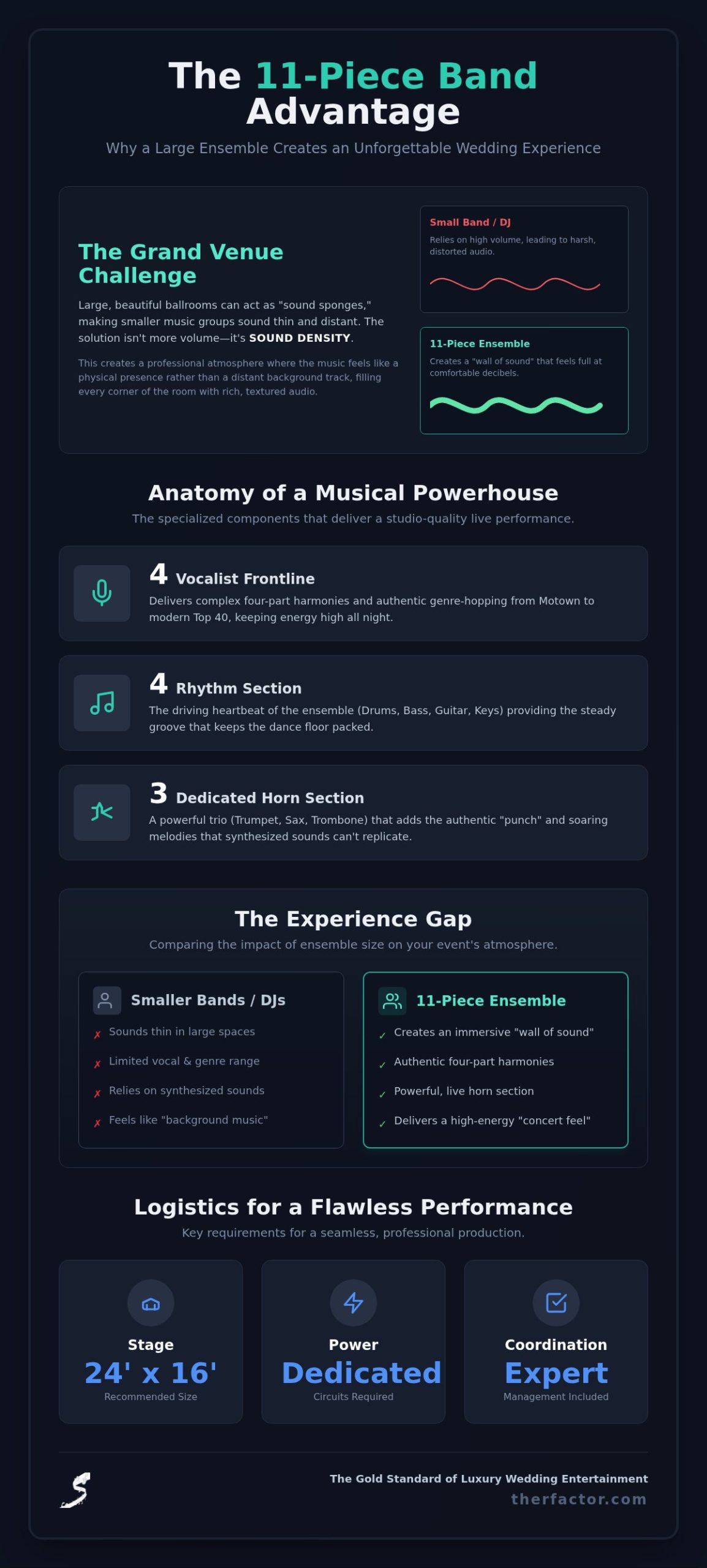
- Booking an 11 piece wedding band Minneapolis requires specific logistical planning, including a recommended 24’x16′ stage and dedicated power circuits.
- The layering effect of an 11-piece ensemble creates a wall of sound that smaller groups cannot replicate, resulting in a high-energy concert experience.
- Professional management through Marsh Productions ensures that all technical requirements and event coordination are handled with expert precision.
Why Sound Density Matters for Your Minneapolis Wedding
A luxury wedding in a grand Minneapolis venue requires a specific sonic strategy. Sound density is the ability of a group to saturate a room with music without relying on aggressive, ear-splitting volume. When you book an 11 piece wedding band Minneapolis has to offer, you aren’t just buying more noise. You are investing in a rich, textured presence that fills every corner of a large ballroom. It creates a professional atmosphere where the music feels like a physical presence rather than a distant background track.
Grand Twin Cities locations like The Depot or the Hilton Minneapolis feature soaring ceilings and vast square footage. These architectural marvels are beautiful, but they often act as “sound sponges.” A small group or a DJ using digital tracks often sounds thin and distant in these spaces. To compensate, they often turn up the master volume, which leads to distorted audio and guest discomfort. A large musical ensemble, such as a 10 to 12 piece group, solves this by providing multiple points of acoustic origin. This creates a “wall of sound” that feels immersive rather than intrusive.
Filling the Room Without Overpowering the Conversation
Counterintuitively, a larger band can be easier on the ears than a small one. Because you have more instruments, individual amplifier volumes can stay lower. The energy comes from the collective vibration of live horns, strings, and percussion rather than a single set of speakers. This allows the music to feel “full” at a lower decibel level, which is the hallmark of a sophisticated event.
Acoustic instruments, like the violin and brass found in premium configurations, provide a warmth that digital samples cannot replicate. This is particularly effective in open-concept warehouse venues where sound bleed can be a nightmare. A professional 11 piece wedding band Minneapolis couples choose for these spaces uses their natural resonance to anchor the sound. It keeps the music focused on the dance floor while allowing guests at the back of the room to enjoy their conversations without shouting.
The ‘Concert Feel’ vs. ‘Background Music’
A wedding reception shouldn’t feel like a playlist on shuffle. It should feel like a curated, once-in-a-lifetime performance. The psychological impact of a full stage cannot be overstated. When guests see 11 professionals, including a four-vocalist frontline and a full horn section, they realize they aren’t just at a party; they are at a concert. This visual scale translates directly into dance floor energy. A crowded stage creates an undeniable gravitational pull. It signals to your guests that the entertainment is a priority, encouraging them to engage rather than observe. By choosing this gold standard of luxury entertainment, you ensure your reception is a high-energy event that commands attention from the first note.
Anatomy of an 11-Piece Band: The Musical Engine
An 11-piece band is a sophisticated musical machine. It’s built on a foundation of specialized roles that work together to create a studio-quality experience live on stage. When you choose an 11 piece wedding band Minneapolis couples trust, you are securing a lineup that includes a full rhythm section, a dedicated horn section, and a versatile vocal frontline. This specific configuration ensures every song sounds like the original recording, only better.
The rhythm section, consisting of drums, bass, guitar, and keyboards, serves as the driving heartbeat of the ensemble. They provide the steady groove that keeps the party moving. Premium groups often include an “X-Factor” musician, such as a percussionist or a violinist, to add unique textures and modern flair. This complexity allows the group to handle everything from elegant dinner jazz to high-octane dance hits without missing a beat.
The Vocal Frontline Advantage
A four-vocalist frontline is the secret to authentic genre-hopping. Most smaller bands struggle with the vocal range required to switch from the gritty soul of Motown to the crisp production of modern Top 40 hits. With four distinct voices, the group can perform complex four-part harmonies that add a professional polish to every chorus. This arrangement also allows singers to rotate leads. It keeps the energy high and the performances fresh throughout a long evening. It’s the difference between a band that simply covers a song and one that truly performs it.
The Power of a Dedicated Horn Section
The horn section, typically comprised of a trumpet, saxophone, and trombone, acts as the musical punctuation for your event. Synthesized keyboard horns can’t replicate the physical “punch” of real brass hitting the air. These instruments provide the iconic stabs and soaring melodies found in funk, soul, and big-band classics. In funk and soul arrangements, the three-piece horn section provides the sharp rhythmic accents that drive the energy of the dance floor.
Beyond the sound, the visual impact of a synchronized horn section adds a level of showmanship that captivates guests. If you want to see how this complex engine works in practice, you can explore the flexible configurations offered by elite local ensembles to find your perfect fit. This level of musical depth ensures that your reception remains a high-energy, concert-style experience from start to finish. You don’t have to worry about the music sounding thin; the sheer scale of the group guarantees a full, immersive atmosphere.
11-Piece vs. Smaller Ensembles: The Sound Gap
Choosing between a standard 6-piece band and a full 11-piece ensemble is about more than just the number of people on stage. It’s about the “sound gap”-the difference between a group that simply plays notes and one that recreates the rich layering of a studio recording. Most modern music isn’t written for a four-piece rock group. It’s built with brass, strings, and multiple vocal tracks. An 11 piece wedding band Minneapolis couples choose provides the necessary sonic architecture to perform these songs with total authenticity.
When you hear a small band in a large room, the sound often feels “thin.” This happens because they lack the physical instruments required to fill the frequency spectrum. A larger group fills that space with organic sound rather than artificial volume. This creates a more comfortable, immersive experience for your guests.
Repertoire Breadth and Authenticity
Authenticity is the benchmark of high-end entertainment. Consider the discography of Earth, Wind & Fire or Stevie Wonder. These tracks require a full horn section and complex vocal harmonies to sound right. A 6-piece band usually forces a keyboard player to trigger digital samples of these instruments. This results in a flat, synthetic sound. An 11-piece group delivers the physical punch of real brass and the depth of four-part live harmonies. This capability extends to modern pop hits that rely on heavy production layering. When you hear these songs played by a full ensemble, the energy is visceral. For a deeper look at how to select the right group for your specific date, consult our Live Wedding Music Minneapolis: The Ultimate 2026 Planning Guide.
The Continuous Music Experience
Momentum is the most valuable currency at a wedding reception. When a small band takes a break, the live music stops. The shift to a DJ playlist often signals a lull to guests, causing them to leave the dance floor for the bar or the exits. Large ensembles solve this through staggered breaks. With 11 musicians, the group can rotate members. A core 7-piece unit remains on stage while others rest, ensuring the live performance never halts. This keeps the energy curve of the night unbroken. Your guests stay engaged because the show never ends.
From a value perspective, the per-musician cost actually decreases as you scale. You’re getting a significantly more powerful musical engine without doubling your logistical overhead. It’s a calculated choice for those who refuse to compromise on the atmosphere of their celebration. You don’t just get more musicians; you get a more resilient and versatile entertainment solution. Before finalizing your decision, reviewing a comprehensive list of questions to ask a wedding band before booking can help you evaluate any ensemble with confidence and avoid costly surprises.
Logistics for Large Bands in Minneapolis Venues
Managing an 11 piece wedding band Minneapolis venues can accommodate requires more than just a large room. It demands a sophisticated understanding of technical requirements and spatial planning. While a smaller group might squeeze into a corner, an elite ensemble operates as a professional production unit. Successful execution depends on coordinating with your venue coordinator to ensure the physical and technical infrastructure is ready before the first guest arrives. We take pride in handling these details so you don’t have to worry about the mechanics of the performance.
Acoustic considerations vary wildly across the Twin Cities. Historic ballrooms with high ceilings offer natural resonance, while modern, glass-heavy spaces can create harsh reflections. A professional sound engineer is essential for a group of this size. They manage the individual levels of eleven different sources to ensure the audio remains crisp and balanced. This professional oversight prevents the “mushy” sound often associated with large groups in difficult rooms. It’s the difference between a loud band and a high-fidelity musical experience. The same principles that apply here also govern live music for product launch Minneapolis events, where technical precision and brand-aligned atmosphere are equally critical.
Stage and Space Planning
The recommended dimensions for an 11-piece setup are typically 24’x16′. This footprint provides enough room for the drum kit, keyboards, and a three-piece horn line to perform without feeling cramped. Showmanship requires movement. If the stage is too small, the visual impact of your vocal frontline is diminished. You should also maintain a clear “dance floor buffer” of at least six feet between the stage edge and the first row of guest tables. This space allows the sound to blossom and gives the performers room to interact with the crowd safely. Clear communication with your venue about these dimensions is the first step toward a stress-free evening.
Technical and Power Requirements
A full-scale event band requires at least three to four dedicated 20-amp circuits to power the sound system, backline, and stage lighting safely. Relying on shared outlets can lead to mid-party outages or equipment damage. Logistics also dictate the timeline of your wedding day. An 11-piece ensemble requires a minimum three-hour setup window for load-in, soundcheck, and lighting calibration. This rigorous preparation ensures that every technical detail is perfect before your guests enter the space. These requirements are consistent whether you are planning a wedding or reviewing our 2026 Guide to Live Music for Corporate Events. To ensure your venue is fully prepared for a large-scale performance, consult with our production experts for a detailed technical rider.
The R Factor: Minneapolis’s Premier Large-Scale Ensemble
The R Factor represents the pinnacle of live entertainment in the Twin Cities. Since 1994, this ensemble has set the standard for what an 11 piece wedding band Minneapolis couples select should deliver. With over 30 years of experience, we’ve mastered the art of the “wall of sound.” Our specific configuration features four vocalists, a full horn section, and a violin. This provides a musical depth that smaller groups simply cannot match. This isn’t just about playing music; it’s about providing a complex, risk-free solution for your most important day.
Managing a large-scale event is a significant undertaking. That’s why every performance is managed by Marsh Productions. This partnership provides you with professional management and the peace of mind that every detail, from technical riders to timeline coordination, is handled with precision. You don’t have to worry about the logistics of the band because we’ve already mastered them. Our team takes the weight of coordination off your shoulders, allowing you to focus on your guests.
A Legacy of Excellence in the Twin Cities
Experience matters when you’re performing in historic Minneapolis venues. We’ve played nearly every major ballroom in the city. This familiarity means we know the acoustics of the room and the specific power requirements of the stage before we arrive. High-end wedding planners in the region frequently recommend us because of our reputation for “reading the room.” We don’t just follow a setlist. We adjust the energy live based on your guests’ engagement, ensuring the dance floor remains full until the final note.
Booking Your 2026 Celebration
Your wedding is unique, and your entertainment should reflect that. We offer flexible configurations ranging from 6 to 12 pieces, allowing you to tailor the ensemble to your guest count and venue size. Securing an 11 piece wedding band Minneapolis venues can accommodate is a statement of quality and a commitment to your guests’ experience. One of our most distinct features is the inclusion of a violin, which allows for a seamless transition from an elegant ceremony to a high-energy reception. To understand how to maximize this instrument’s impact throughout your event, our guide to wedding reception violin music in Minneapolis offers expert strategies for integrating strings into every stage of your celebration.
Integrating the band into your wedding timeline is essential for maximum impact. We work with you to ensure the music complements every moment, from the grand entrance to the last dance. If you’re planning other events, you might also find value in The Ultimate Guide to Booking a Private Party Band in Minneapolis (2026). Choosing the right ensemble is the safest way to guarantee a high-quality experience for your 2026 celebration. We invite you to partner with a team that has the knowledge and passion to make your vision a reality.
Elevate Your Reception with a Concert-Scale Performance
Selecting the right entertainment is the single most impactful decision for your reception’s energy. An 11 piece wedding band Minneapolis venues can support provides a sonic depth that transforms a standard party into a professional concert experience. You’ve seen how sound density fills a room without overpowering guests and how a dedicated horn section creates authentic, high-energy hits. These elements are not luxuries; they are the foundation of a packed dance floor.
The R Factor brings 30+ years of experience to every stage. We offer durable 6 to 12 piece flexibility to match your vision and venue perfectly. Because every event is managed by Marsh Productions, you can trust that all technical logistics and coordination are handled with expert precision. You deserve a partner that understands the nuances of the Twin Cities’ most prestigious venues and takes the weight of planning off your shoulders.
Ensure your celebration is unforgettable by partnering with a team that has mastered the art of live performance. Secure The R Factor for Your 2026 Minneapolis Wedding and experience the difference that true musical expertise makes. We look forward to setting the stage for your perfect night.
Frequently Asked Questions
How much space does an 11-piece wedding band actually need?
An 11-piece ensemble typically requires a stage measuring 24 feet by 16 feet. This footprint allows for the drum kit, keyboards, and a dedicated horn line to perform comfortably while maintaining high visibility for the vocalists. If your venue has a non-standard layout, we can often adjust the configuration. It’s best to confirm these dimensions with your venue coordinator early in the planning process to ensure a seamless fit.
Is an 11-piece band too loud for a smaller guest count?
A larger ensemble is not necessarily louder; it simply provides more sound density. Because we have more acoustic instruments, we don’t need to rely on high amplifier volumes to fill the room. This creates a warm, immersive environment that feels sophisticated rather than overpowering. Even with a guest count under 150, an 11 piece wedding band Minneapolis couples choose will deliver a full, concert-quality sound that remains comfortable for conversation.
What is the price difference between an 8-piece and an 11-piece band?
The cost difference reflects the additional musical layers and authentic genre-switching capabilities provided by the larger group. While an 8-piece band is a strong choice, scaling up to 11 pieces adds a full horn section and multiple vocalists. This investment transforms the performance from a standard reception band into a specialized musical engine. Most clients find that the increased energy and “wall of sound” provide significantly more value per musician as the lineup grows.
Does a 10 or 11-piece band include a sound technician?
Every large-scale performance includes a professional sound technician to manage the complex audio requirements of eleven different sources. This expert ensures that the mix remains balanced and crisp, regardless of the room’s acoustics. They monitor levels in real-time, preventing feedback and ensuring that the vocal harmonies and horn stabs are perfectly blended. This technical oversight is a non-negotiable part of our commitment to delivering a high-fidelity concert experience.
Can an 11-piece band play during my wedding ceremony or cocktail hour?
We frequently provide music for every stage of your wedding day. Our flexible configurations allow us to feature a solo violinist or a small jazz trio for your ceremony and cocktail hour before the full 11-piece ensemble takes the stage for the reception. This creates a cohesive musical thread throughout the event. Integrating these smaller units into your early timeline ensures a smooth transition into the high-energy performance that follows. For a comprehensive look at how to incorporate strings throughout your entire event, explore our guide to wedding reception violin music in Minneapolis to discover how a professional violinist can elevate every stage of your celebration.
What genres does an 11-piece band perform best?
An 11-piece ensemble excels at performing high-energy genres that require complex arrangements. Funk, soul, and Motown classics sound most authentic because we use a real brass section rather than synthetic samples. Additionally, the four-vocalist frontline allows us to replicate the heavy layering found in modern Top 40 and pop hits. This versatility ensures that every song in our repertoire of over 750 tracks sounds like a studio-quality production.
How many power outlets does a large band require?
A full-scale event band typically requires three to four dedicated 20-amp circuits. These must be separate from the venue’s lighting or catering power to avoid mid-party outages or technical interference. Our production team coordinates directly with your venue to confirm these technical details well in advance. Ensuring the electrical infrastructure is ready is a critical step in maintaining the safety and reliability of our professional sound and lighting systems.
How long does it take for an 11-piece band to set up and soundcheck?
We require a minimum three-hour window for load-in, setup, and a comprehensive soundcheck. This time allows our crew to calibrate the audio for your specific venue’s acoustics and ensure the stage lighting is perfectly positioned. Large groups involve significant technical complexity, and this dedicated window guarantees that everything is perfect before your guests arrive. We prioritize a stress-free process by being fully prepared long before the first note is played.
Recent Comments